Hallux valgus: what makes everyday life easier
In this article
Note: This article contains affiliate/advertising links. As an Amazon Associate we earn from qualifying purchases. If you click such a link and buy something, we may receive a small commission – at no extra cost to you.
The bump sticks out, the big toe drifts towards its neighbour, and sooner or later every second pair of shoes starts to pinch: hallux valgus – commonly called a bunion – is one of the most common foot deformities, and it affects women far more often than men. This guide explains factually how the deformity develops and what genuinely eases everyday life: choosing shoes, padding and aids, maintaining mobility, and skin care. It is not a substitute for a medical examination and offers no treatment recommendation.
What is hallux valgus?
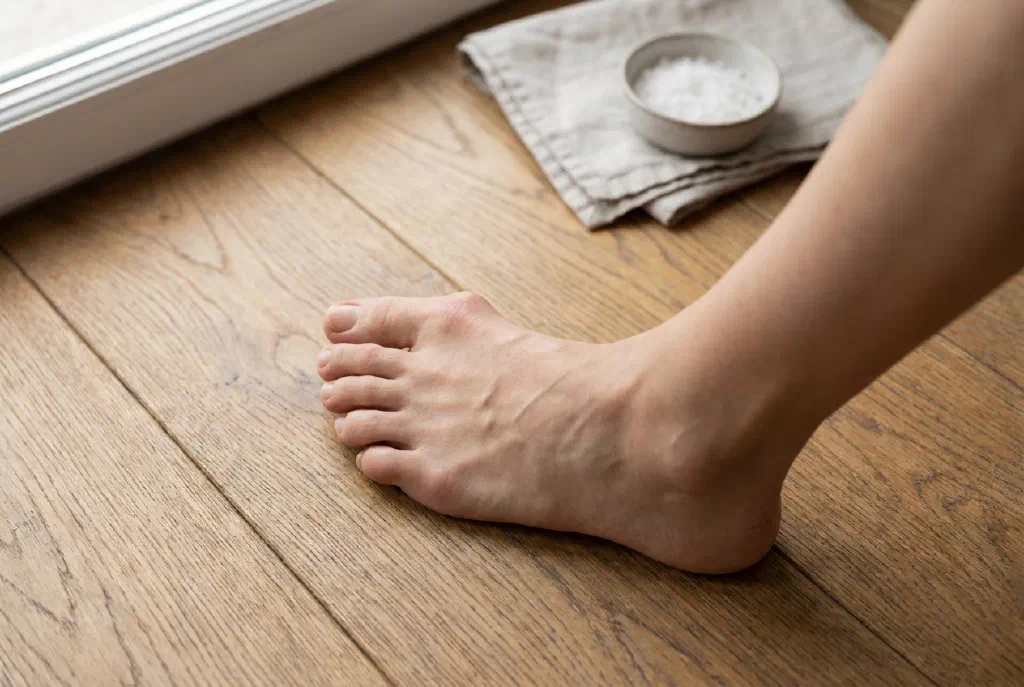
With hallux valgus, the position of the big toe changes: it tilts outward towards the second toe, while the joint at its base protrudes inward. That protruding bony prominence is what most people know as the “bunion” – it is not an extra growth, but the displaced joint itself.
The deformity develops slowly, often over years. At first, usually only the appearance is bothersome. Later comes the pressure: the bump rubs against the inside of the shoe, and the skin over it thickens, reddens or becomes sensitive. If the big toe drifts further over or under the second toe, that toe may give way and develop a deformity of its own – frequently a hammer toe.
One important point of perspective: how far the toe deviates and how much it hurts are not necessarily related. What counts is everyday life – and that can be influenced, even when the position of the toe stays as it is.
How hallux valgus develops
There is rarely a single cause. Usually several factors work together:
- Predisposition: Foot shape, joint mobility and connective tissue strength run in families. If your mother and grandmother had a bunion, the likelihood is higher.
- Splay foot: The transverse arch in the forefoot drops, the forefoot widens, and the toes lose their alignment. A splay foot is considered the most common precursor – hallux valgus is often its consequence.
- Footwear: Pointed toe boxes and high heels push the big toe outward over the years. Shoes do not cause the deformity on their own, but they can encourage an existing tendency.
- Connective tissue and life stages: Hormonal changes, for instance during pregnancy or menopause, loosen the connective tissue. This is one reason why women are affected more often.
- Constant load: Long periods of standing, a lot of walking on hard floors and higher body weight all increase pressure on the forefoot.
Choosing shoes: the biggest lever in everyday life
No other point makes as much difference as quickly as the right shoe. What matters:
- A wide, high toe box: The toes must be able to spread without hitting the sides. One test: stand on a removable insole – if your foot overhangs at the sides, the shoe is too narrow.
- A flat to moderate heel: The higher the heel, the more weight lands on the forefoot and therefore on the bump.
- Soft uppers: Soft leather or knitted material gives way over the bump instead of rubbing. Hard seams sitting directly over the bump are unfavourable.
- Buy in the evening: Feet are slightly larger later in the day. Trying shoes on in the morning easily means buying too snug.
Insoles, pads and toe spreaders
There are plenty of aids on the market for bunions. Realistically assessed:
Insoles support the dropped transverse arch and distribute pressure across the forefoot more evenly. With pronounced complaints, an individually fitted solution after a professional assessment is worthwhile.
Bunion pads and pressure protectors made of gel or silicone sit between the bump and the shoe and reduce friction. That is pure comfort – helpful against chafing, with no influence on the position.
Toe spreaders and night splints hold the big toe in a straighter position for a while, which many people find a pleasant stretch. Honesty matters here: an existing bony deformity is not permanently corrected by them – the toe returns to its position once the aid is removed. As a comfort measure, such aids can still make sense for many people, as long as they do not press or constrict.
Maintaining mobility
A hallux valgus cannot be exercised away – plenty of promises online say otherwise, and they do not hold up. What foot exercises can do: strengthen the foot muscles, support the transverse arch, maintain mobility in the joint at the base of the big toe, and release tension in the forefoot.
Gentle classics are sensible: consciously spreading the toes and closing them again, bunching up a towel with the toes, carefully guiding the big toe into a straighter position by hand and holding briefly, rolling the sole over a ball. Walking barefoot at home challenges the foot muscles too. You will find more exercises under Foot exercises: simple workouts. The same rule applies throughout: gentle, pain-free, better a short session daily than a long one rarely.
Caring for the skin over the bump
Where there is constant pressure, the skin reacts. Calluses, thickened skin or a corn readily form over the bump. A calm routine has proved its worth: a lukewarm foot bath to soften, then careful reduction with a file or pumice stone, and a rich cream – supple skin cracks less often.
Important: do not cut it yourself. Blades, callus planes and razors have no place at the bunion – the risk of injury is high, and an open wound on an already irritated pressure zone is a genuine problem. Stubborn corns belong in podiatric hands. With diabetes or circulatory problems, self-treatment is off limits entirely, see Foot care with diabetes.
When to see a doctor or orthopaedist?
Medical advice is appropriate when:
- there is pain, it increases, or it occurs even at rest,
- the bump is red, warm or swollen – which may indicate inflammation around the joint,
- walking is restricted or you start avoiding distances,
- the skin is open or becomes inflamed,
- the deformity progresses rapidly or pushes the neighbouring toes aside,
- diabetes, circulatory disorders or nerve conditions are present – any change to the foot should then be assessed early.
An orthopaedic practice can examine the foot and advise on the options. Surgical procedures exist – whether one is an option is solely a matter of individual medical advice.
Frequently asked questions (FAQ)
Can hallux valgus be reversed without surgery?
No. An existing bony deformity cannot be permanently bent back with splints, spreaders or exercises – even though it is often advertised that way. What is possible: easing complaints, maintaining mobility and making daily life more comfortable.
Do toe spreaders or night splints help?
Many people find them pleasant, because they stretch the forefoot and ease the feeling of tightness. They have no lasting influence on the position of the toe. As a comfort measure there is nothing against them, as long as nothing presses or constricts – with complaints, have it assessed by a professional first.
Which shoes are suitable with hallux valgus?
Shoes with a wide, high forefoot area, soft uppers and a flat to moderate heel. Pointed models, high heels and hard seams directly over the bump are unfavourable.
Can I prevent hallux valgus?
It cannot be prevented entirely, because predisposition plays a part. What helps: shoes with enough room in the forefoot, high heels as the exception rather than the rule, regular foot exercises and barefoot time at home – the later the pressure starts, the better.