Dermaplaning: Smooth Skin Through Gentle Exfoliation Explained
In this article
Note: This article contains affiliate/advertising links. As an Amazon Associate we earn from qualifying purchases. If you click such a link and buy something, we may receive a small commission – at no extra cost to you.
Dermaplaning sounds more spectacular at first than it actually is: using a special, sterile blade, fine hairs and dead skin flakes are removed from the outermost layer of skin in flat, sweeping strokes. The result is smoother, more even skin on which make-up applies more uniformly and skincare products absorb better. In this guide you will learn exactly how dermaplaning works, who it is suitable for and what advantages and disadvantages you should know before trying it.
What exactly is dermaplaning?
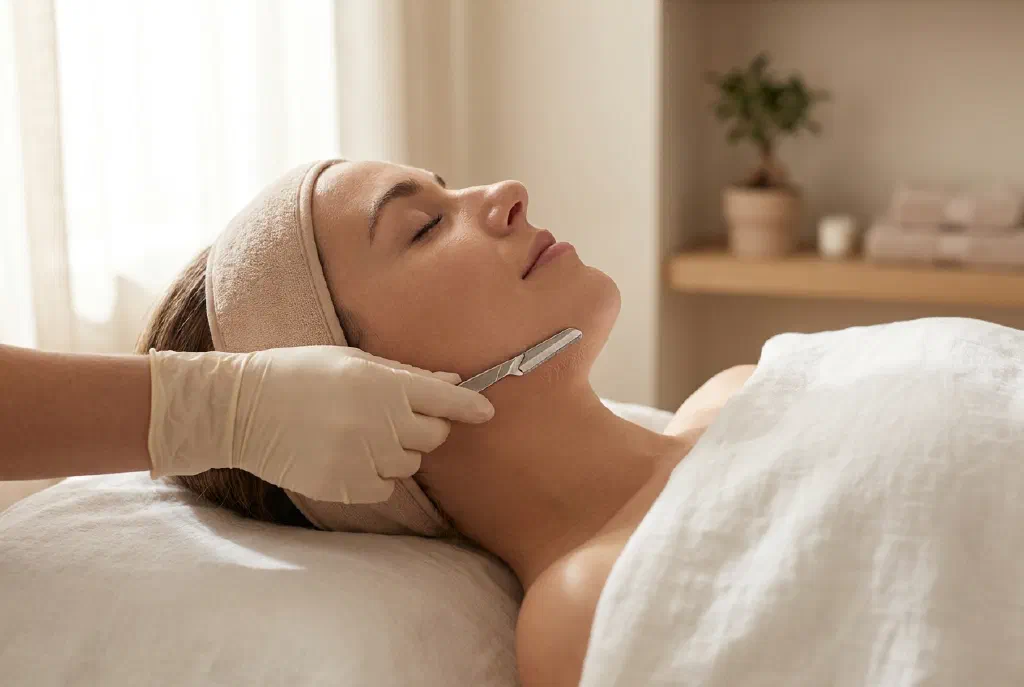
Dermaplaning is a form of mechanical exfoliation, meaning the physical removal of the outermost layer of skin. Unlike a chemical peel, no acids or enzymes are used, but rather a sharp, slightly curved blade. This is guided across the dry, cleansed skin at a flat angle of about 45 degrees.
Two things happen at the same time:
- The dead horny cells (corneocytes) on the skin’s surface are loosened and removed.
- The fine, light vellus hairs – colloquially known as “peach fuzz” – are shortened or removed.
The procedure affects only the outermost layer of the epidermis. It does not work into deeper layers of the skin and is therefore clearly distinct from procedures such as microneedling.
How does a treatment work?
In the studio, the beautician first thoroughly cleanses your face and removes make-up as well as sebum residue. The skin must be completely dry so that the blade glides evenly. The skin is then gently stretched section by section and the blade is guided in short, even strokes – usually from the center of the face outward.
A complete treatment usually takes 20 to 40 minutes and is painless. Many experience the sensation as a pleasant, light scratching. After the removal, a soothing treatment with serum, mask or moisturizer often follows. Because the skin barrier is temporarily more permeable, active ingredients absorb particularly well during this phase.
Studio or at home?
There are simple dermaplaning tools for home use, but they remove significantly less material and are mainly aimed at the peach fuzz. The professional version with a surgically sharp blade belongs in trained hands, as otherwise the risk of injury increases. If you are unsure, an appointment at a beauty studio is the safer choice.
The benefits at a glance
Dermaplaning is popular because the result is immediately visible. The most important benefits include:
- Instantly smoother skin: The complexion appears softer and more even right after the treatment.
- More radiant look: By removing dull horny flakes, the skin reflects light more evenly.
- Better absorption of active ingredients: Serums and creams penetrate more easily because the dead horny layer is reduced.
- Make-up-friendly: Foundation and powder apply more smoothly and settle less into hairs or flakes.
- Suitable for many skin types: Dry and normal skin in particular benefit.
A common misconception concerns the hairs: vellus hairs do not grow back thicker or darker after removal. The hair structure does not change due to shortening – the hairs may only feel a little stubblier for a short time as they grow back.
Disadvantages and possible risks
As pleasant as the result is, dermaplaning also has downsides you should be aware of:
- Irritation and redness: Right after the treatment the skin may be slightly red or sensitive.
- Risk of injury: With improper application, small cuts can occur.
- Increased light sensitivity: Freshly exfoliated skin reacts more sensitively to UV radiation.
- No effect on dark terminal hairs: Strong hairs, such as those on the chin, are not permanently removed.
Dermaplaning is not suitable for active acne, inflamed pustules, open areas, sunburn, rosacea flare-ups or very sensitive, reaction-prone skin. The blade can spread inflammation across the skin and intensify irritation. If you suffer from a skin condition or are unsure, you should have its suitability medically clarified when in doubt.
Skincare after dermaplaning
Because the skin barrier is temporarily weakened, proper aftercare is important. Note the following points:
- Avoid aggressive active ingredients such as high-dose acids or retinol for one to two days.
- Rely on mild, moisturizing care to soothe the skin.
- Consistently apply sun protection, as the skin reacts more sensitively to UV radiation.
- Avoid the sauna, intense sweating and heavy friction immediately afterward.
If your skin needs additional soothing after exfoliation, a gentle procedure such as an Enzympeeling: das sanfte Peeling für empfindliche Haut can be a gentle alternative or complement during the care-free period. Because active ingredients absorb better right after removal, a soothing, moisturizing mask also works particularly well – which one suits your skin is shown in the guide to the right face mask for every skin type. An LED-Lichttherapie für die Haut: rotes und blaues Licht erklärt also combines well with dermaplaning, since active ingredients and light work particularly well on the skin after removal.
How often does dermaplaning make sense?
Since a treatment removes the outermost horny layer, the skin needs time to regenerate. An interval of about four weeks is common – this roughly corresponds to the natural renewal cycle of the epidermis. More frequent removal can overwhelm the skin barrier and lead to dryness or irritation. Listen to your skin: if it feels tight or irritated, a longer break makes sense.
Frequently asked questions (FAQ)
Do the hairs grow back thicker after dermaplaning?
No. The fine vellus hairs change neither their color nor their thickness through removal. They may feel a little stubblier for a short time as they grow back, because the tip has just been cut off, but they grow back just as fine.
Is dermaplaning suitable for every skin type?
Dry and normal skin benefits the most. For active acne, inflammation, rosacea or very sensitive skin, dermaplaning is not advisable, as irritation can be intensified. When in doubt, you should have its suitability medically clarified.
Does dermaplaning hurt?
No, the treatment is usually painless. Most people feel only a slight, scratching sensation on the skin’s surface. Mild redness right afterward is normal and usually subsides quickly.
How does dermaplaning differ from a peel?
Dermaplaning is a mechanical exfoliation with a blade, while chemical peels work with acids or enzymes. Dermaplaning additionally removes the fine facial hairs, which a chemical peel does not do.