Microneedling: Effects, Procedure and What It Achieves
In this article
Note: This article contains affiliate/advertising links. As an Amazon Associate we earn from qualifying purchases. If you click such a link and buy something, we may receive a small commission – at no extra cost to you.
Microneedling is one of the best-known methods when it comes to firming the skin from within and refining its appearance. The principle sounds contradictory at first: fine needles create tiny, controlled injuries in the skin in order to kick-start its natural self-healing. It is precisely this stimulus that prompts your skin to produce new collagen and elastin. In this guide you will learn how collagen induction works, which skin concerns microneedling is suited to and what you should keep in mind during aftercare.
What is microneedling?
Microneedling – also known as collagen induction therapy (CIT) – is a method in which a device with many fine needles is guided across the skin. Depending on the treatment goal, the needles penetrate to different depths and create micro-fine channels. These micro-injuries are so small that they are barely visible to the naked eye, yet sufficient to put the skin into repair mode.
Different tools are used:
- Dermaroller: a roller with numerous needles that is rolled across the skin.
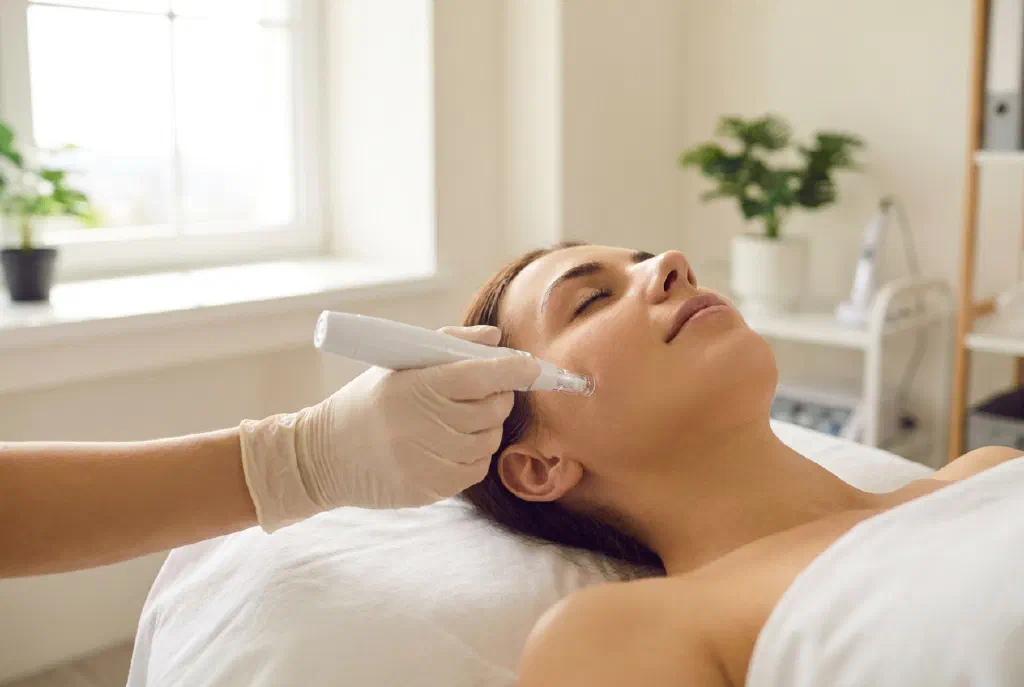
- Microneedling pen: a pen-like device in which the needles are moved rapidly up and down by a motor and the depth can be set precisely.
While professional treatments in a studio or clinic work with longer needles and greater precision, home devices are considerably shorter and primarily designed for superficial care.
How does collagen induction work?
The key to the effect lies in your skin’s natural wound healing. The tiny channels trigger a chain reaction that can be roughly described in three phases:
- Stimulation: The micro-injuries signal to the body that there is a need for repair at this spot.
- Regeneration: Growth factors are activated and stimulate the formation of fresh collagen and elastin.
- Remodelling: Over the course of weeks, new connective tissue is formed, making the skin appear firmer and more elastic.
Collagen is the supporting framework of your skin – over the years its production naturally declines, causing the skin to lose firmness. Microneedling targets exactly this point and gives the process a deliberate nudge. A pleasant side effect: through the opened channels, certain active ingredients from serums can penetrate the skin better immediately after the treatment.
Which skin concerns is microneedling suitable for?
Microneedling is versatile and is used above all for the following concerns:
- Fine lines and reduced firmness thanks to the stimulated collagen production.
- Enlarged pores and an overall uneven skin texture.
- Acne scars and flat scars, whose structure can even out over several sessions.
- Irregular pigmentation and a dull complexion.
Realistic expectations are important: microneedling smooths and refines, but does not replace more far-reaching aesthetic procedures. Deep wrinkles or pronounced skin sagging cannot be completely eliminated with it. If your main concern is rather a build-up of dead skin cells or an uneven complexion, a fruit acid peel can be a sensible alternative or addition. If you mainly want a more even, evenly tinted complexion, it is also worth looking at semi-permanent BB Glow for the face.
When it is better to avoid it
Not every skin benefits from microneedling. In the case of active acne, open inflammation, an active herpes outbreak, psoriasis or eczema in the treatment area, you should avoid it. Caution is also advised if you are prone to raised scars (keloids) or during treatment with blood-thinning medication. When in doubt, have your suitability clarified by a doctor or dermatologist.
How does a treatment work?
A professional session usually follows a clear pattern:
- Cleansing and disinfection of the skin to avoid germs.
- Numbing cream for deeper applications, so that the treatment is more comfortable.
- Microneedling itself: the device is guided evenly across the individual facial zones.
- Soothing care with a matching serum or mask directly afterwards.
The actual treatment often takes only 20 to 40 minutes. Immediately afterwards the skin is frequently reddened and feels like after a mild sunburn. For a visible result, several sessions a few weeks apart are usually necessary, since collagen build-up takes time.
Aftercare: how to support the result
The care after the treatment plays a decisive role in the result and skin health. In the first few days your skin barrier is weakened and particularly sensitive.
- Sun protection is a must: avoid direct sun and consistently apply a high SPF.
- Cleanse gently and temporarily avoid irritating active ingredients such as highly concentrated acids or retinol.
- Provide moisture with mild, soothing products free of fragrances and alcohol.
- Hands off peels, sauna and intense exercise for one to two days.
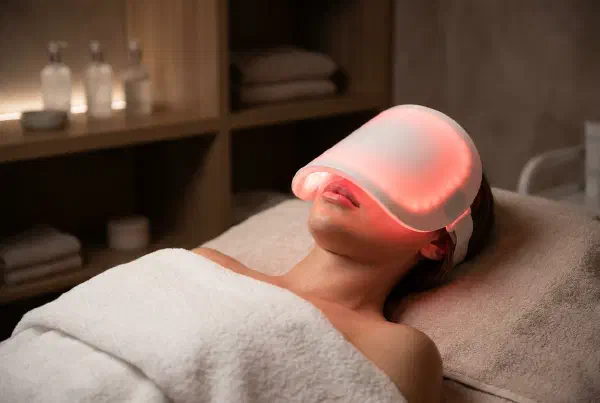
You should not scratch off any crusts or flakes, but let them heal naturally. To gently stimulate circulation on treatment-free days, a Gua Sha facial massage is also suitable, once the skin has fully calmed down again. As a gentle, non-irritating method on calmed skin, LED light therapy for the skin also combines well with microneedling.
What does microneedling realistically achieve?
Microneedling is not an instant miracle, but a method that relies on repetition and patience. Over several sessions, the skin can appear finer, more even and firmer, because it gradually builds up new supporting tissue. Those who stick with it regularly and take aftercare seriously usually see a refined, fresher skin appearance. The decisive factor for a safe result is a clean, professional execution – especially for deeper applications, microneedling belongs in trained hands.
Before and after: drag the slider
Here is how an interactive before-and-after comparison works (demo – your own treatment photos can be used here):

 Vorher
Nachher
Vorher
Nachher
Frequently Asked Questions (FAQ)
Is microneedling painful?
The sensation depends on the needle depth. Superficial applications usually only feel slightly tingling. For deeper treatments, a numbing cream is generally applied, so that the treatment is easy to tolerate.
How many sessions do I need?
For a visible result, three to six sessions a few weeks apart are often sensible. Since collagen build-up takes time, the full effect only shows gradually.
Can I do microneedling at home?
Home rollers with very short needles serve primarily for superficial care and better absorption of active ingredients. Genuine collagen induction with deeper needles belongs in professional hands for reasons of hygiene and safety.
When will I see the first results?
Fresher, slightly firmer skin often appears after a few weeks. Structural changes, such as with scars, require several sessions and corresponding patience.