Hair Removal Cream Done Right: Smooth Without a Blade
In this article
Note: This article contains affiliate/advertising links. As an Amazon Associate we earn from qualifying purchases. If you click such a link and buy something, we may receive a small commission – at no extra cost to you.
Smooth skin without cuts, without prickly stubble the next morning and without complicated technique – that is exactly what hair removal cream promises. It dissolves the hair right at the skin’s surface instead of slicing it off like a razor. That sounds simple, but precisely because it works chemically, correct application matters. Anyone who leaves the cream on too long or skips the skin test risks redness and burning. In this guide you’ll learn how hair removal cream works, how to use it safely and how to keep your skin happy in the process.
How does hair removal cream work?
Hair removal cream works chemically, not mechanically. Its mode of action is usually based on so-called thioglycolates in a slightly alkaline environment. These substances break the sulfur bridges in keratin – the protein that hair is made of. As a result, the hair loses its structure and becomes so soft that it can simply be wiped or rinsed away together with the cream.
The key difference compared to shaving: the cream doesn’t just remove the hair flush with the surface, it dissolves it a little way inside the skin opening. The result therefore often feels smoother than after shaving, and the regrowing hairs seem less stubbly because no sharp cut edge is created. However, since the hair root remains untouched, the result lasts about as long as shaving – usually a few days.
Preparation: skin test and skin condition
Before you apply a hair removal cream over a large area, a tolerance test is a must. Put a small amount on an inconspicuous spot of skin, observe the indicated leave-on time and watch the area for around 24 hours. If itching, strong redness or burning occurs, the product isn’t for you.
Also pay attention to the condition of your skin:
- Never use the cream on injured, sunburned or irritated skin.
- Don’t apply it to moles, warts or inflamed areas.
- Keep your distance from mucous membranes, eyes and the area around the eyebrows.
- Don’t shave or exfoliate the skin immediately before use, otherwise it will be more sensitive.
The skin should be clean and dry. Residues of oil, lotion or deodorant can impair the effect.
Step by step: applying it correctly
The exact procedure is always on the packaging – this guide is the general outline:
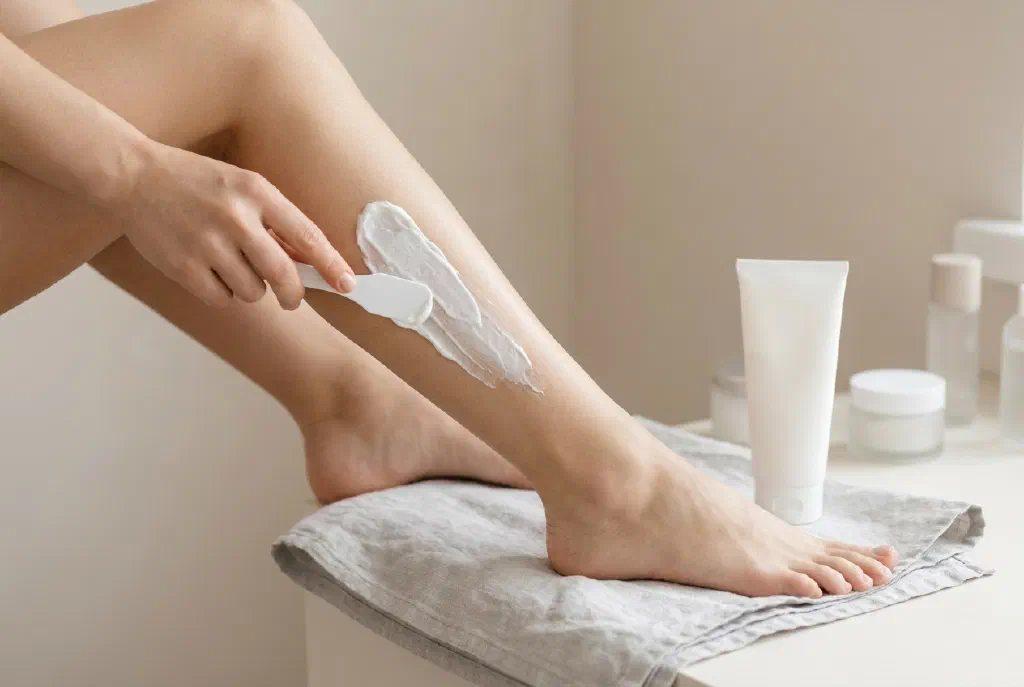
- Apply: Spread the cream with the included spatula or its back in an even, covering layer. The hair should be fully covered, but don’t rub the cream into the skin.
- Let it work: Keep to the leave-on time exactly – it’s usually between five and ten minutes. More isn’t better, it just irritates the skin. It’s best to set a timer.
- Test: Wipe the cream off a small spot. If the hairs come away easily, you can carry on.
- Remove: Take the cream off along with the hair using the spatula or a damp cloth. Then rinse thoroughly with lukewarm to cool water until no residue is left.
- Soothe: Pat the skin dry and treat it to a mild, fragrance-free moisturizer once it no longer feels sensitive.
Never exceed the leave-on time just to catch that last little hair. If a few hairs remain, it’s better to catch them next time than to over-irritate the skin.
Avoiding skin irritation and soothing the skin
Burning or redness after use is usually a sign that the cream was on the skin too long or that the skin generally reacts sensitively. Here’s how to prevent it:
- Shorten the leave-on time if you tend to be sensitive – a little less time is better than too much.
- After use, avoid fragrance, self-tanner, deodorant (for underarms) and intense sun for at least 24 hours.
- Avoid hot showers, sauna or chlorinated water right afterwards.
- Don’t additionally shave or exfoliate on the same day.
- Care for the skin with cooling, low-irritant products without alcohol and fragrances.
If you alternate between different methods, it’s worth taking a look at Shaving Done Right: Smooth Skin Without Spots and Irritation, because there too, preparation and aftercare decide the result.
Where can you use hair removal cream?
Most creams are intended for legs, arms, underarms and the bikini area – but there are different formulations for different body zones. A cream for the legs isn’t automatically suitable for more sensitive areas.
In the genital area in particular, caution is advised: here you should only use products that are explicitly designated for the intimate area, and strictly avoid the mucous membranes. If you want to be on the safe side here, our article Intimate Shaving and Intimate Waxing: Gentle Hair Removal in the Intimate Area offers further gentle alternatives.
For the face, such as the upper lip, there are special, milder facial creams. Regular body products don’t belong there. When in doubt – for example with very sensitive skin, skin conditions or uncertainty about a product – it’s best to seek medical or professional cosmetic advice.
Frequently Asked Questions (FAQ)
How long does the result of hair removal cream last?
Usually a few days – similar to after shaving, since the hair root remains intact. Many people find the regrowth more pleasant, though, because no hard cut edge forms and the stubble feels softer.
Why does the hair removal cream burn on my skin?
A slight tingling can be normal, but distinct burning is not. It’s usually due to too long a leave-on time or sensitive skin. In that case, rinse the cream off immediately with cool water. If the irritation persists or is severe, you should stop using the product and, when in doubt, have it checked by a doctor.
Can I use hair removal cream right before swimming or sunbathing?
Better not. The skin is more sensitive right after use, so you should avoid sun, chlorinated and salt water for around 24 hours to prevent irritation.
Is hair removal cream better than shaving?
That depends on your skin and your preferences. The cream works without any risk of cutting and often leaves a smoother feeling, but it takes more time and can irritate sensitive skin. It’s best to test both methods and decide which is more pleasant for you.