SPF in Everyday Life: How to Use Sun Protection Correctly
In this article
Note: This article contains affiliate/advertising links. As an Amazon Associate we earn from qualifying purchases. If you click such a link and buy something, we may receive a small commission – at no extra cost to you.
Many people associate sun protection only with the beach, summer and the pool. Yet UV radiation hits your skin all year round and in any weather. The face in particular is exposed to the sun unprotected every day, because you can hardly cover it with clothing. Once you understand what the sun protection factor really does and how to apply it correctly, you turn facial sun protection into a simple routine that noticeably relieves your skin over the long term.
What the sun protection factor really means
The sun protection factor (SPF) indicates how much longer you can theoretically stay in the sun before your skin reacts to UVB radiation with redness. If your unprotected self-protection time is ten minutes, for example, an SPF of 30 extends this time mathematically by a factor of thirty. In practice, however, this calculation is only a rough guide, because sweating, friction and applying too thin a layer significantly shorten the protection.
The difference between the types of radiation is also important:
- UVB radiation causes sunburn and acts mainly on the upper layer of skin.
- UVA radiation penetrates deeper, contributes to premature skin ageing and is also effective through window glass.
Good facial sun protection should therefore be broad-spectrum and cover both UVB and UVA. Look for the “UVA” mark in a circle or an indication of a broad protection spectrum on the packaging.
Why daily facial SPF makes sense
UV radiation knows no season. Even on cloudy days, a large part of the UVA radiation reaches your skin, and in the shade radiation is reflected from bright surfaces. The face is particularly affected by this, because it almost always remains uncovered.
Regular sun protection helps preserve the skin from the consequences of constant UV exposure. These include, among other things, premature wrinkling, uneven pigment spots and a tired, dull complexion. Anyone with sensitive skin or skin prone to redness often additionally benefits from the soothing effect, because less UV stimulus reaches the skin.
Sun protection does not replace medical check-ups. If you notice changes in your skin such as new or changing pigment moles, you should have them checked by a doctor when in doubt.
How to apply sun protection correctly
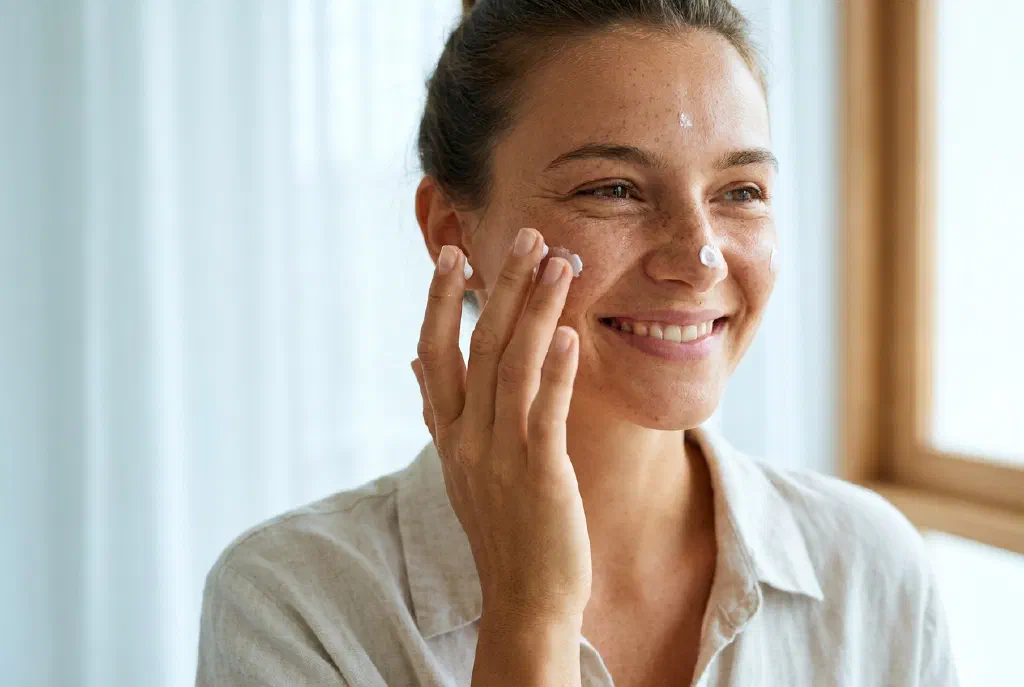
The most common mistake is the amount. Studies show that most people use far too little product and thus achieve only a fraction of the stated protection. For the face, the so-called two-finger rule serves as a guide: you squeeze one strip of sun protection onto your index finger and one onto your middle finger and spread this amount over your face and neck.
Here is how to proceed step by step:
- Cleanse your face and apply your usual skincare.
- Let the skincare absorb briefly before the sun protection follows.
- Spread the SPF evenly and do not forget your ears, neck, temples and hairline.
- Wait a few minutes before applying make-up so the film stays stable.
Sun protection is usually the last skincare step before make-up. If your skin tends to be dry, a rich base care underneath can make sense; you can read more about this in the article Caring for dry skin: what provides moisture and protection. For oily skin, light, mattifying textures help so nothing feels heavy or looks shiny.
Reapplying: the often forgotten step
Sun protection breaks down over the course of the day. Sweating, abrasion from touching and rubbing reduce the protective film. That is why a single application in the morning is often not enough once you are outside for a longer time.
As a rule of thumb: In intense sun and during outdoor activity, reapply every two hours. On a normal office day indoors, this is needed less often, but as soon as you spend a longer time outdoors, freshening up is worthwhile.
Practical options over make-up are:
- Sun protection sprays or sticks that can be applied without smudging.
- Tinted products with SPF, if you want to refresh your complexion at the same time.
- Powder-based filters, which layer well over existing make-up.
Keep in mind that these touch-up products only work if you use them in sufficient quantity. A wafer-thin layer does not replace a full application.
Finding the right SPF for you
Which factor makes sense depends on your skin type, the time of day and your activities. For the face in everyday life, a high factor is a good choice, because this area of skin is permanently exposed.
- Fair, sensitive skin type: a tendentially higher SPF, since the self-protection time is short.
- Longer stays outdoors: consistently high protection and regular reapplication.
- Sensitive skin or skin prone to blemishes: light, non-comedogenic textures that do not additionally burden the pores.
The right texture often determines whether you really use sun protection every day. A product that feels pleasant and does not stick is far more likely to become a fixed habit than one that weighs the skin down.
Frequently Asked Questions (FAQ)
Do I need SPF in winter and when it is cloudy too?
Yes. UVA radiation reaches your skin even with clouds and a low sun position. The face in particular stays uncovered all year round, so daily sun protection makes sense as soon as you are outside during the day.
Is a day cream with SPF enough?
A day cream with a sun protection factor is a good start, but people often apply too little of it to achieve the stated protection. If you are in the sun for a longer time, it is better to combine it with a dedicated sun protection in sufficient quantity.
Can I wear sun protection under make-up?
Yes. Apply the SPF as the last skincare step and let it absorb briefly before foundation or powder follows. For reapplying over make-up, sprays, sticks or tinted products with a factor are suitable.
Does high SPF prevent a tan completely?
No, not a complete effect, but it significantly reduces UV exposure. A tan is the skin’s protective reaction to radiation. The goal of sun protection is not zero tan, but fewer UV damages over time.