Mud Treatment: Fango and Healing Clay for Skin and Joints
In this article
Note: This article contains affiliate/advertising links. As an Amazon Associate we earn from qualifying purchases. If you click such a link and buy something, we may receive a small commission – at no extra cost to you.
A mud treatment is one of the oldest care applications of all: even in antiquity, people applied mineral-rich mud to their skin and joints to find relaxation and well-being. Today you’ll find mud and fango packs in thermal baths, spas and beauty studios – sometimes as a pleasantly warm heat compress for tense muscles, sometimes as a cleansing mask for the complexion. In this guide you’ll learn how mud, fango and healing clay work, what they are typically used for and what you should keep in mind during application.
What is a mud treatment?
A mud treatment refers to the application of a fine, mineral-rich mud to the skin. Depending on origin and composition, the applications go by different names:
- Fango is a mineral mud of volcanic origin that is often applied heated as a warm pack.
- Healing clay is a finely ground, clay-containing natural product used primarily in cosmetic masks.
- Moor is organic mud from peat bogs and is often used for warming full-body or partial packs.
What they all have in common is a high content of minerals and a fine, creamy consistency that spreads well on the skin. The key difference compared with many other applications lies in the ability to store heat.
How does fango affect skin and joints?
The most important physical effect of a warm mud or fango pack is heat storage. Mineral mud absorbs heat and releases it evenly over a long period. This gentle, lasting warmth works on several levels:
- It stimulates the circulation of the upper skin layers.
- It can loosen tense muscles and create a pleasant feeling of warmth in the tissue.
- It supports general well-being and helps you relax.
That’s why warm fango packs are often used in the area of the back, neck and joints, for example after a strenuous day or alongside a massage. Important: a heat application does not replace medical treatment. In the case of persistent complaints or pain, you should have the cause professionally investigated before relying on heat.
Dosing the heat correctly
The temperature of a fango pack should be pleasantly warm, but never uncomfortably hot. In reputable studios and thermal baths, the mud is brought to a skin-friendly temperature before application and is usually applied on a base or in a cloth so that the heat works evenly. Allow time for rest during the application – the effect develops best when you lie down and relax for 15 to 30 minutes.
Healing clay and mud in cosmetics
In facial and body care, it is mainly the cool variant that plays a role: the mask. Healing clay and fine clay muds have the property of binding excess sebum and dirt particles. As they dry on the skin, a slight tightening effect arises that can visually refine the pores and mattify the complexion.
Typical cosmetic areas of use are:
- Cleansing masks for blemished or shine-prone skin.
- Mattifying applications for the T-zone with combination skin.
- Nourishing body packs that make the skin look supple and well-cared-for.
Since mud and clay masks can draw oil and moisture from the skin, replenishing care afterwards makes sense. After removing the mask, apply a moisturizing cream so that the skin doesn’t feel tight. Very dry or sensitive skin can sometimes react sensitively – here it’s worth a careful test on a small area.
If you want to further intensify your complexion after the mud treatment, a cleansing mask combines well with other studio treatments, such as an Ultrasound treatment: deep care and firming of the skin. For a fresh tan without the sun, a Spray tan: get a tan without the sun applied correctly is also a popular addition.
Course of a mud treatment in the studio
How an application actually proceeds depends on whether the warming or the cosmetic effect is the focus. Broadly, the process can be described as follows:
- Initial consultation: You discuss with the specialist which application makes sense and whether there are any reasons against it.
- Preparing the skin: The relevant body area is cleansed and, if necessary, slightly warmed.
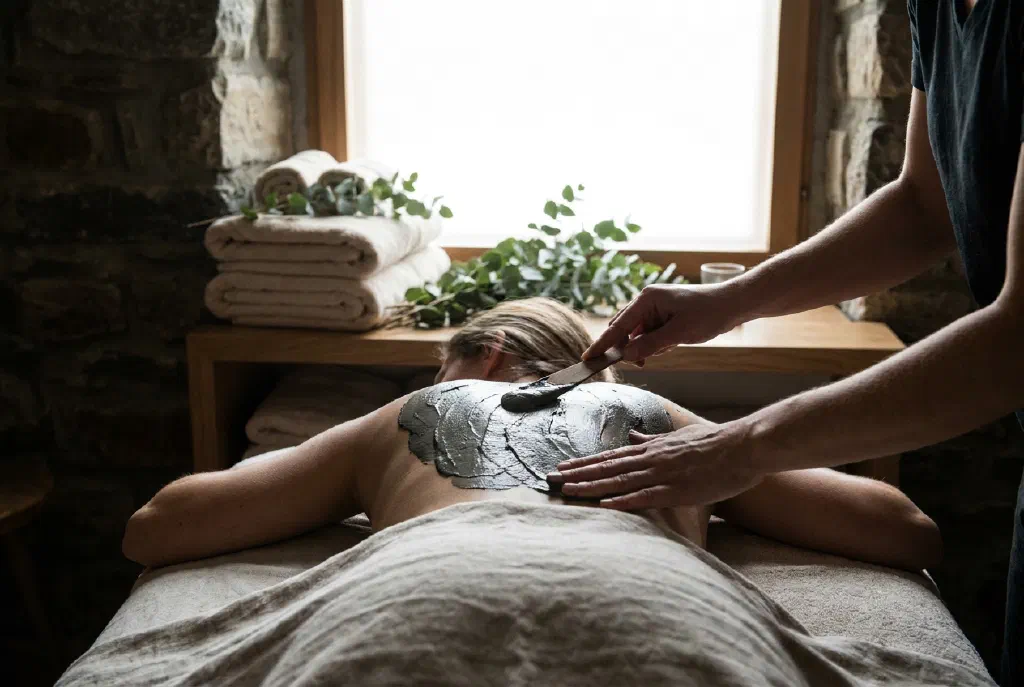
- Application: The mud is applied evenly – warm as a heat pack or cool as a mask.
- Exposure time: You rest while the mud takes effect; often the area is covered to retain heat or moisture.
- Removal and aftercare: The mud is removed, and the skin is cleansed and cared for.
After a warming treatment, rest does you good. Drink plenty of water and avoid major exertion immediately afterwards so that the body can process the heat comfortably.
Who should be cautious?
As soothing as a mud treatment can be – it is not suitable for everyone without restriction. Particular caution applies in the case of:
- acute inflammation, fever or fresh injuries
- cardiovascular diseases or high blood pressure (especially with heat applications)
- broken, irritated or very sensitive skin
- pregnancy
In all of these cases, you should speak with your doctor or a qualified specialist before an application. When in doubt, the rule is: better to check beforehand than to take a risk. A mud treatment is primarily a wellness and care application – not a substitute for medical therapy.
Frequently Asked Questions (FAQ)
What is the difference between fango and healing clay?
Fango is a mineral mud of volcanic origin that is often used heated as a warm pack for muscles and joints. Healing clay is a finely ground, clay-containing natural product and is used primarily in cool, cleansing facial and body masks.
How often can I do a mud treatment?
That depends on your goal and skin type. A cleansing mask can be applied once or twice a week depending on tolerance, while warming packs are more of an occasional wellness application. Pay attention to how your skin reacts and give it breaks in between.
Does a mud mask dry out the skin?
Mud and healing clay bind oil and moisture, so the skin may feel slightly tight after removal. A moisturizing, replenishing care afterwards balances this out and keeps the skin supple.
Does fango help against back pain?
Warm fango packs can loosen tense muscles and are often used alongside relaxation. However, in the case of persistent or severe back pain, this does not replace a diagnosis – in that case, have the cause investigated by a doctor.