Facial Sunscreen: What Actually Matters When You Choose One
In this article
Note: This article contains affiliate/advertising links. As an Amazon Associate we earn from qualifying purchases. If you click such a link and buy something, we may receive a small commission – at no extra cost to you.
Dozens of tubes sit side by side on the shelf: SPF 30, SPF 50+, mineral, “fluid”, “sun serum”, tinted. Which one actually belongs on your face? The choice matters more than most people think, because the best sunscreen is always the one you genuinely apply every day. A product that pills, shines or leaves a grey cast ends up in the back of a drawer within two weeks. This guide helps you decode the label, find the filter type that fits your skin, and apply the cream so the protection actually reaches your face.
What the label really tells you
The sun protection factor (SPF) refers exclusively to UVB radiation, the part that causes sunburn. The number sounds like a linear scale, but it isn’t: SPF 30 filters around 97 percent of UVB, SPF 50 roughly 98 percent. The step up is far smaller than the doubled figure suggests. A high factor still has a practical advantage, though: since almost nobody applies the full test quantity, SPF 50+ leaves you more of a buffer when you go sparingly.
UVA radiation carries its own marking. In the EU you’ll find the UVA symbol inside a circle on the packaging. It means the UVA protection is at least one third of the stated SPF. UVA penetrates deeper into the skin, passes through window glass and contributes substantially to UV-related skin ageing. Without that symbol, a high number only shields you from redness, not from the rest.
Also look for claims such as “water resistant” (a relative term: protection drops after swimming, but doesn’t vanish) and “non-comedogenic” if you’re prone to breakouts.
Why facial sunscreen isn’t just a marketing trick
Chemically speaking, body sunscreen works on your face too. The difference lies in the formulation. Body products are designed for large surfaces and water resistance, which makes them heavy, greasy and strongly film-forming. On facial skin, which is thinner and far denser with sebaceous glands, that causes three problems:
- Clogged pores: heavy oils and emulsifiers can encourage breakouts.
- Shine: the occlusive film acts like a mirror on skin that’s already oily.
- Make-up trouble: foundation slips or clumps on a greasy base.
Facial products, by contrast, come as light fluids, gels, serums or emulsions, usually fragrance-free or low in fragrance and tested for tolerance around the eyes. They cost more per millilitre, but the odds that you’ll actually use them daily are far higher, and that is the whole point.
Chemical or mineral filters?
Both filter types are approved and effective; they differ mainly in how they feel to wear.
Chemical (organic) filters convert UV radiation into heat. They’re invisible, sink in easily and can be formulated elegantly. Modern filter systems cover UVA and UVB broadly. The downside: they need a few minutes to set and can irritate very sensitive skin or the eyes.
Mineral (physical) filters such as zinc oxide and titanium dioxide sit as a layer on the skin and reflect or scatter radiation. They work immediately, count as particularly low-irritation and are therefore a good pick for very sensitive skin. The downside: the notorious white cast, especially on deeper skin tones, and an often matte, dry feel.
Plenty of products combine the two. If you’re torn: sensitive, easily reddened skin usually stays calmer with mineral, while everyone else tends to get a cosmetically nicer result from chemical filters.
Choosing by skin type
If you’re unsure where your skin sits, the guide to determining your skin type will help. Broadly:
- Oily skin: light gels or fluids with a mattifying finish, oil-free, non-comedogenic. For what else helps, see oily skin.
- Combination skin: a light emulsion that doesn’t weigh down the T-zone or dry out the cheeks; more in combination skin care.
- Dry skin: creamy textures with humectants like glycerin or hyaluronic acid, a little richer is fine.
- Sensitive skin: mineral, fragrance-free, short ingredient list.
- Skin prone to pigment spots: high factor, solid UVA coverage, possibly tinted, since pigments additionally shield visible light.
The right amount: where most people fall short
Sunscreen is tested in the lab at 2 mg per square centimetre. Apply only half and you don’t get half the protection, you get considerably less. For face and neck, the test quantity works out to roughly half a teaspoon.
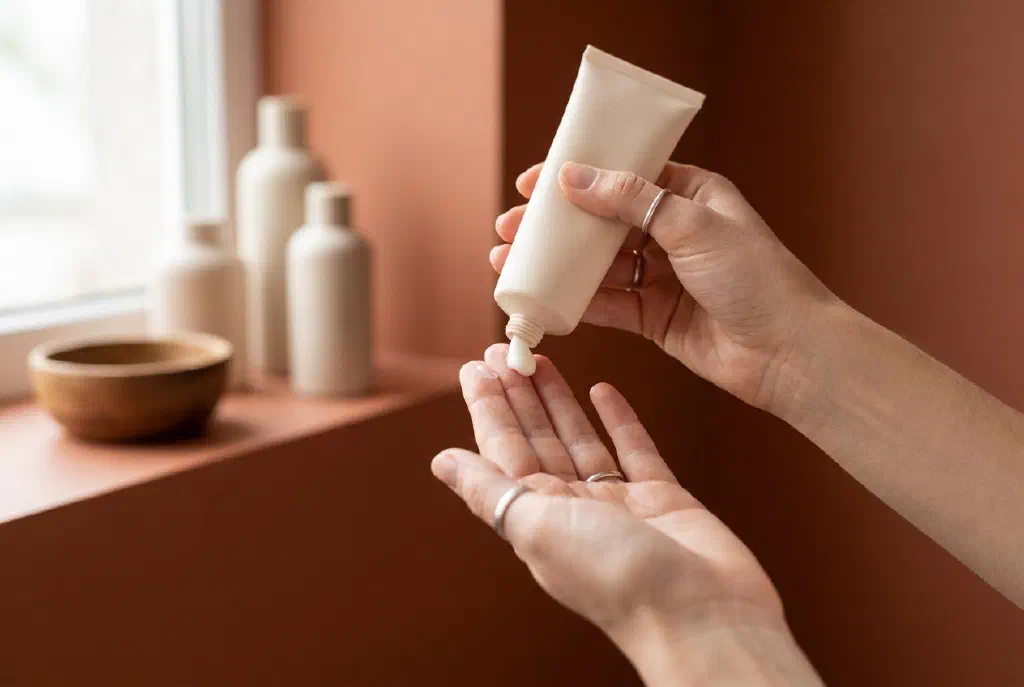
In practice, remember the two-finger rule: squeeze one continuous line of sunscreen onto your index and middle finger, from base to tip. That amount goes on face and neck. It will feel like too much the first time, which is normal.
Two tricks for a better result:
- Apply in two layers rather than all at once, which prevents pilling.
- Press it in rather than rubbing, and spread it flat so the film stays even.
Don’t forget the zones everyone forgets: ears, temples, hairline, neck and lids right up to the lash line.
Where it belongs in your routine
In the morning, sunscreen is the final skincare step and goes on before make-up. Anything applied afterwards dilutes or shifts the film. For how the steps before it should stack, see the guide to the order of your skincare routine.
Pilling (little rolls on the skin) usually happens when layers aren’t compatible or follow each other too quickly. The remedy: fewer products, let each layer settle briefly, and don’t pair silicone-based base care directly with heavily gel-like serums.
The white cast of mineral products can be softened by applying a smaller amount in two passes, or by reaching for a lightly tinted version.
And finally: UVA radiation reaches your skin in winter and under cloud cover too, as it barely depends on temperature or sunshine. For how to turn that into a fixed daily habit, including reapplying on the go, read using SPF properly in everyday life.
Frequently Asked Questions (FAQ)
Is SPF 50 really better than SPF 30?
On paper the difference is small: around 97 versus 98 percent of UVB filtered. In practice SPF 50+ is still worth it for the face, because hardly anyone applies the full test quantity. The higher factor partly compensates for that thriftiness.
Can I use body sunscreen on my face?
It protects just the same in principle. But it’s usually heavier, greasier and more strongly fragranced, which encourages shine, breakouts and problems under make-up. For daily use a facial product is the more comfortable and therefore more practical choice.
How do I avoid the white cast from mineral sunscreen?
Apply the amount in two thin passes rather than one thick layer, and press it in instead of rubbing it around. Tinted mineral products even out the grey veil further, because iron oxides pick up your skin tone.
Do I need sunscreen if I’m indoors all day?
Next to a window, yes; otherwise not strictly. UVA passes through ordinary window glass, UVB barely does. If you spend the day at a desk beside a large window front or drive a lot, daily protection serves you better than it does someone in an interior room.