Spray Tan: How to Get an Even Tan Without the Sun
In this article
Note: This article contains affiliate/advertising links. As an Amazon Associate we earn from qualifying purchases. If you click such a link and buy something, we may receive a small commission – at no extra cost to you.
Sun-kissed skin without spending hours in the blazing sun or on a tanning bed: that’s exactly what a spray tan promises. A fine tanning mist is applied evenly to your skin and, after a few hours, develops into a natural-looking tint. To make the result even rather than blotchy or orange-tinged, good preparation and the right aftercare matter most. In this guide you’ll learn how a spray tan works, how to prepare optimally and how to keep the tan looking beautiful for as long as possible.
How does a spray tan work?
The heart of every spray tan is the active ingredient DHA (dihydroxyacetone), a substance derived from sugar. It reacts with the amino acids in the uppermost, dead cells of your horny layer. This reaction – the so-called Maillard reaction – causes the skin to take on a brownish colour. Important to know: it provides no sun protection. A spray tan only colours the skin; it does not protect you from UV radiation. So you still need sunscreen when you’re in the sun.
The tint doesn’t develop immediately, but over several hours. Right after application you often see only a light, temporary colour from the colour pigments contained in the product. The actual final result usually appears after 6 to 24 hours. Since only the uppermost layer of skin is coloured, the tan gradually fades as the skin naturally sheds.
The right preparation
An even result stands and falls with the preparation. Because the active ingredient reacts with the uppermost layer of skin, it is absorbed more strongly on rough or flaky areas – and that’s exactly where blotches form. Here’s how to prepare your skin optimally:
- Exfoliate the day before: Remove dead skin cells one to two days beforehand with a gentle body scrub. This is especially worthwhile on knees, elbows, ankles and hands.
- Shave or remove hair early enough: Shave or remove hair at least 12 to 24 hours beforehand so that the irritated skin can calm down and the pores are closed.
- No creams and no make-up: Arrive at your appointment with clean, dry and cream-free skin. Oils, lotions and deodorant form a barrier and prevent the tan from adhering evenly.
- Comfortable, dark clothing: After application, wear loose, dark clothes, as the tanning mist can rub off at first.
If your skin tends to be dry, intensive care in the days beforehand can be helpful – but not directly on the day of treatment. If you’re also interested in skin firming, the tan is sometimes combined with treatments such as an ultrasound treatment for deep skincare and firming, though this should be done at a separate time.
The procedure at the studio
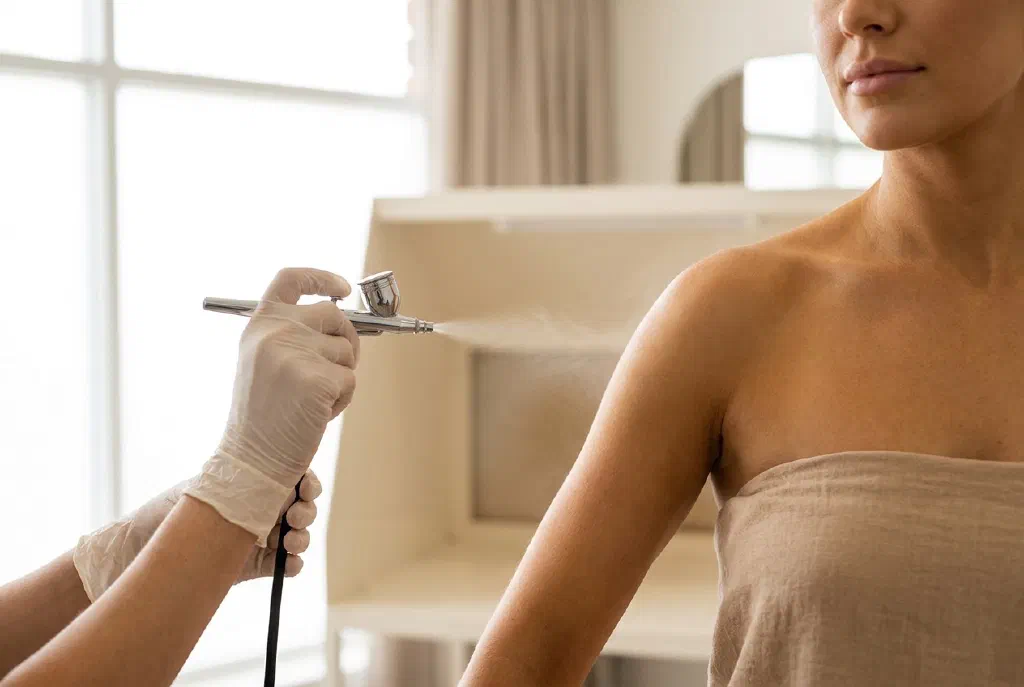
At the studio you step into a special booth or are treated by a professional with a spray gun (airbrush). The application itself usually takes only 10 to 20 minutes. You take various poses one after another so that all parts of the body are reached evenly. An experienced professional can control the intensity precisely and, for example, gently emphasise contours.
After application, you should let the layer dry. In the first few hours, the rule is:
- Don’t shower and don’t sweat until the tan has developed.
- Avoid water: No swimming pool, no sauna and no intense exercise.
- Tight clothing, belts or bras can leave pressure marks – so choose loose-fitting items.
The exact development time depends on the product and will be communicated to you at the studio. Only the first shower rinses off the excess pigments and reveals the actual result.
Keeping the tan looking good for longer
To keep the spray tan even for as long as possible, gentle care matters. Since the tan fades as the skin renews itself, the rule of thumb is: the less friction and the more moisture, the longer it lasts.
- Moisturise daily: A rich, low-fragrance body lotion keeps the skin hydrated and delays shedding.
- Shower gently: Avoid aggressive scrubs, hard sponges and very hot water. Pat yourself dry after showering instead of rubbing.
- Avoid chlorine and salt water: Both can fade the tint more quickly.
- Watch out for friction: Frequent hand washing, tight clothing and intense rubbing make heavily used areas fade faster.
If you want to refresh the tan, it’s best to wait until it has largely faded and start again with an exfoliation. This prevents layers from building up unevenly on top of one another. If you’d like to expand your care routine anyway, treatments such as body wrapping for firming and detoxifying make a sensible addition – again, ideally at a different time from the tan.
Who is a spray tan suitable for?
In principle, a spray tan is suitable for most skin types, as it doesn’t involve any UV exposure. Still, there are a few points to keep in mind:
- With sensitive skin, allergies or skin conditions, caution is advised. When in doubt, have a small test done on an inconspicuous spot beforehand, or have the application checked medically or professionally.
- During pregnancy, you should discuss the application with your doctor beforehand.
- Avoid inhaling the tanning mist. Studios usually use nose filters or protective measures for this.
This is how you get an even tan that flatters your skin tone – completely without the sun. With the right preparation, a steady hand during application and consistent care afterwards, nothing stands in the way of a natural complexion.
Frequently Asked Questions (FAQ)
How long does a spray tan last? As a rule, the tan remains visible for about 5 to 10 days. Exactly how long depends on your skin type, your care routine and how often you shower, sweat or create friction on the skin. With daily moisturising, you can noticeably extend its longevity.
Does a spray tan protect against the sun? No. The active ingredient DHA only colours the uppermost layer of skin but offers no UV protection. In the sun, you still need to use a sunscreen with a sufficient sun protection factor to prevent sunburn and skin damage.
Why is my spray tan blotchy? Blotches usually result from dry or rough skin areas, residue from cream or deodorant, or contact with water too soon. Thorough exfoliation beforehand, cream-free skin during application and patience during the development time are the best way to prevent uneven results.
Can I exercise normally after a spray tan? In the first few hours you should avoid sweating and intense exercise, as sweat can make the not-yet-developed tan run. After the first shower and once the tint has set, you can be active again as usual.