Ultrasound Treatment: Deep Care and Skin Firming
In this article
Note: This article contains affiliate/advertising links. As an Amazon Associate we earn from qualifying purchases. If you click such a link and buy something, we may receive a small commission – at no extra cost to you.
Ultrasound treatment is one of the most versatile applications in modern cosmetics. Using inaudibly high-frequency sound waves, active ingredients can be delivered deeper into the skin, impurities gently dissolved and the connective tissue stimulated. What makes it special: the method works completely without needles, without incisions and usually without any significant downtime. In this guide, you will learn how ultrasound works in skincare, what it is suitable for and what to keep in mind before booking a treatment.
How Ultrasound Affects the Skin
Ultrasound refers to sound waves above the range of human hearing. In cosmetics, frequencies in the range of around 1 to 3 megahertz are mostly used. These vibrations are transmitted to the skin via a handpiece, where they create tiny, very rapid pressure changes.
This results in two key effects:
- Thermal effect: The micro-vibrations generate a gentle warmth in the deeper layers of the skin. This promotes blood circulation and the metabolism of the tissue.
- Mechanical effect: The vibrations act like a micro-massage. They loosen adhesions, stimulate the connective tissue and support lymphatic flow.
This combination is what makes ultrasound so flexible: depending on the frequency, intensity and the gel used, a treatment can be geared more towards cleansing, ingredient delivery or firming.
Delivering Active Ingredients With Sonophoresis
A central area of application is what is known as sonophoresis. The idea behind it is that sound waves temporarily make the skin barrier more permeable, so that skincare ingredients can penetrate deeper than with purely topical application.
In practice, the beautician applies a serum or a special gel, for example with moisturising or soothing ingredients. The ultrasound head then moves these active ingredients evenly into the upper layers of the skin. Frequently used ingredients include:
- Hyaluronic acid for more moisture and firmness
- Vitamin C as an antioxidant for a fresher complexion
- Panthenol or aloe vera to soothe irritated skin
Important to know: the depth of action is limited and does not replace medical treatment. It primarily aims for a visibly well-cared-for, plumper complexion.
Deep Cleansing and Exfoliation
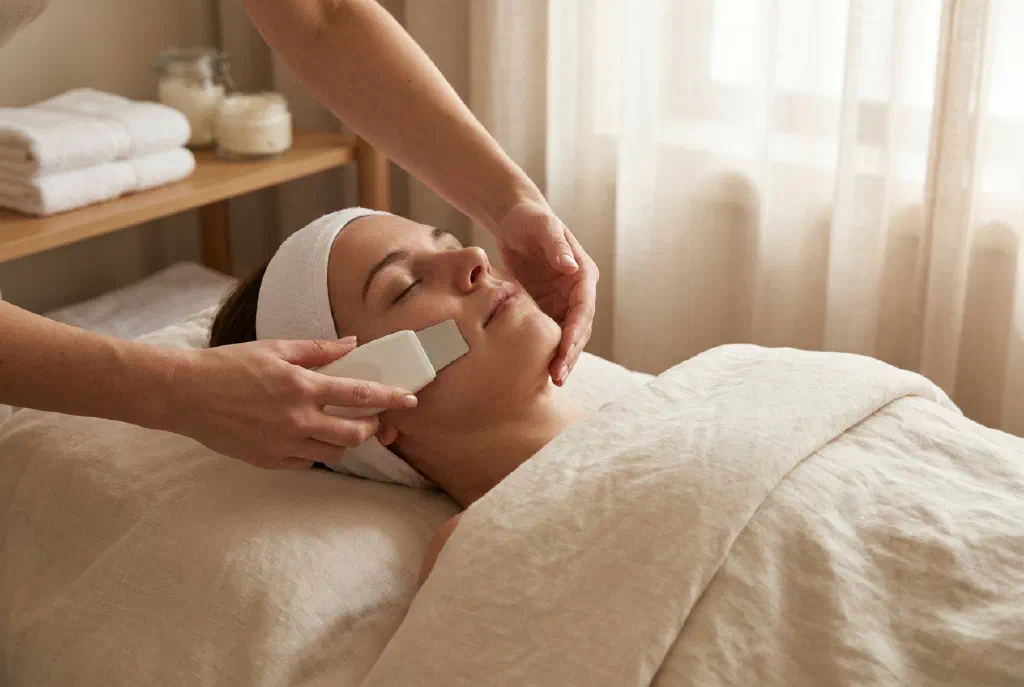
Before delivering active ingredients, ultrasound is often used for deep cleansing. With a flat metal spatula tip that vibrates at high frequency, dead skin flakes, excess sebum and dirt can be loosened from the pores. This variant is also referred to as ultrasound peeling or skin scrubber.
The advantage over mechanical extraction: the method works more gently and irritates the skin less. It is therefore also suitable for more sensitive skin types, but should be professionally assessed in the case of acutely inflamed or acne-prone skin.
Firming and Stimulating Collagen Production
With the stimulated blood circulation and the gentle warmth, the ultrasound treatment also aims at firming. The idea behind it: if the connective tissue is stimulated, this can support the natural production of collagen and elastin – the fibres that give the skin firmness and elasticity.
The results are usually subtle and develop over several sessions. A fresher, somewhat smoother complexion is realistic, not a dramatic lift. Anyone aiming for noticeable skin firming on the body often combines ultrasound with other procedures. You can find related approaches in our article on Cellulite treatment: which methods really help as well as on Body wrapping: body wraps for firming and detoxifying. Radiofrequency treatment for firming skin likewise uses heat to stimulate the connective tissue.
Course of a Treatment
A typical facial ultrasound treatment proceeds in several steps:
- Cleansing: The skin is thoroughly freed of make-up and dirt.
- Contact gel: A gel or serum is applied so that the sound waves are transmitted optimally.
- Ultrasound: The handpiece is guided over the skin in circular movements – this usually feels like a gentle warming or tingling.
- Finishing care: Finally, suitable care and, if necessary, sun protection follow.
A session lasts about 20 to 45 minutes depending on the area. For visible results, several appointments at intervals of one to two weeks are often recommended.
Who Is the Treatment Suitable For?
In principle, ultrasound treatment is suitable for most skin types that want to refine their complexion or intensify their care. However, there are situations in which you should be cautious and seek professional or medical advice beforehand:
- with acute skin inflammations, open wounds or infections
- with electronic implants such as a pacemaker
- during pregnancy
- with metal implants in the treatment area
- with certain skin diseases or recent cosmetic procedures
When in doubt: it is better to seek medical or professional clarification one time too many before starting a treatment.
Frequently Asked Questions (FAQ)
Is an ultrasound treatment painful?
No. Most people find the treatment pleasant. Usually only a gentle warmth and a soft vibration on the skin are noticeable.
How many sessions do I need for a visible result?
That depends on the condition of the skin and the goal. A course of several sessions at intervals of one to two weeks is often recommended, followed by occasional refresher appointments. A single treatment can make the skin appear fresher, but only lasts for a short time.
Can I combine ultrasound with other care methods?
Yes, ultrasound combines well with cleansing and active-ingredient treatments. Ask your beautician for advice on which combination suits your skin type and what intervals make sense.
Are there any side effects?
When applied correctly, there are usually no or only mild reactions such as temporary redness. If irritation persists, you should pause the application and, when in doubt, have it professionally assessed.