Ballerina Nails: Shape, Difference From Almond and How-To
In this article
Note: This article contains affiliate/advertising links. As an Amazon Associate we earn from qualifying purchases. If you click such a link and buy something, we may receive a small commission – at no extra cost to you.
Ballerina nails – more commonly called “coffin nails” in English – are one of the most elegant long shapes in modern nail design. Their signature feature is the straight-cut tip: the sides taper inward but are filed flat at the end instead of coming to a point. That shape calls to mind either a ballet pointe shoe or a coffin, which is where the two names come from. In this guide you’ll learn what defines the ballerina shape, how to clearly tell it apart from almond, stiletto and the pure coffin, who it suits and how to file it yourself, step by step.
What are ballerina nails?
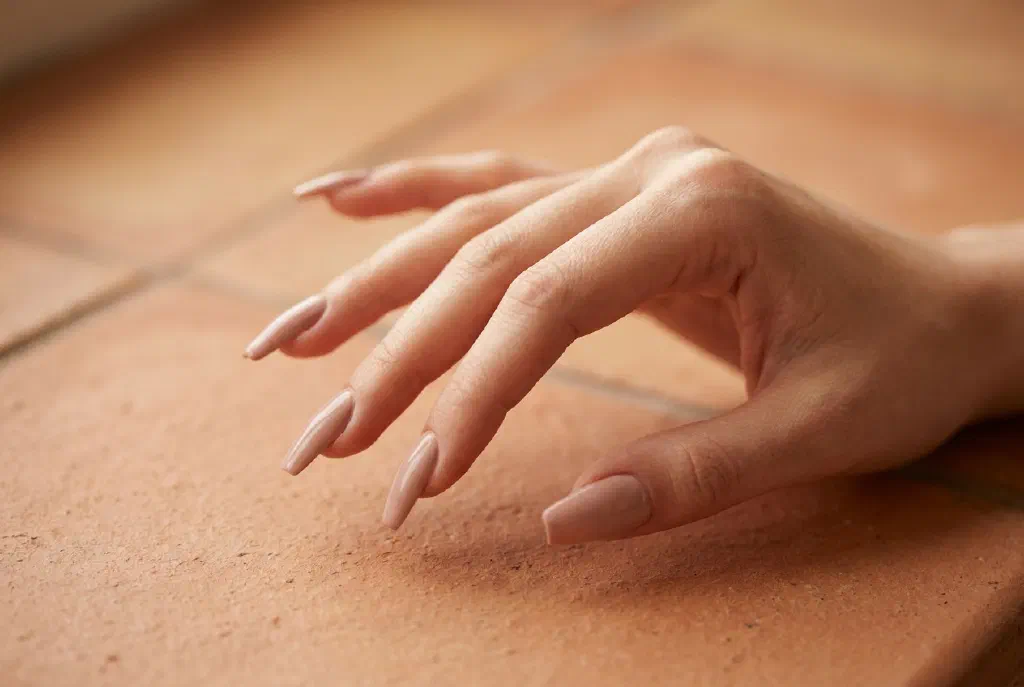
The ballerina shape (coffin) is a long nail shape in which the side walls taper toward the tip and are cut straight across at the end. This creates a slim, almost trapezoid silhouette with a flat tip edge.
- Lengthening: The tapering sides make fingers and the nail bed look longer and finer.
- Clean line: The straight tip gives the hand a graphic, modern look – a favourite among influencers and on red carpets.
- A canvas for design: The wide, flat tip is ideal for designs like French, baby boomer or chrome.
For an overview of all the common shapes – from round and oval to square – see our guide to nail shapes at a glance.
Ballerina, almond, coffin, stiletto: the differences
These four long shapes are often confused. Here’s how to tell them apart cleanly:
- Ballerina (coffin): Sides taper, tip is cut straight across (flat edge). Trapezoid.
- Coffin (in the strict sense): Essentially the same shape. “Ballerina” and “coffin” describe the same look – “ballerina” is just the more flattering name. Some file the coffin slightly more angular and shorter, the ballerina a touch finer and longer.
- Almond: Sides taper, but end in a rounded tip – like an almond. No flat edge. More on this in our guide to almond nails.
- Stiletto: Runs out to a sharp point like a thorn. The most dramatic, but the most fragile and the least everyday-friendly.
A handy rule: almond is round at the front, stiletto is pointed at the front, ballerina is straight at the front. If you love the drama of a stiletto but need more stability, you usually end up with the ballerina.
Who does the ballerina shape suit?
The ballerina shape needs length – that’s its most important requirement. Only a sufficiently long free edge lets you file the sides slim and still keep a clean straight tip.
- Long natural nails or extensions: On short nails the shape looks squashed. Anyone with naturally short nails usually combines it with gel or acrylic as an extension.
- Narrow to medium nail beds: The lengthening effect shows best here.
- Wide nail beds: Possible too, but taper more gently so the tip doesn’t look too wide and chunky.
- Everyday wear with judgement: Very long ballerina nails are demanding day to day (typing, getting dressed). A moderate length is the best compromise between looks and practicality.
Step by step: how to file ballerina nails
Here’s how to bring an existing length (natural nail or enhancement) into shape. Important: always file in one direction – our guide on filing nails in the right direction explains why.
- Set the length: Decide on your desired final length. Leave it a touch longer – you can shorten the straight tip later.
- Cut the tip straight: First file the nail tip flat and straight, as if you were creating a square shape. This edge becomes the ballerina tip.
- Angle the sides: Now file both side walls diagonally from the tip down toward the nail wall, so the nail visibly tapers. Work symmetrically on both sides.
- Soften the corners: Lightly take the sharp edge off the corners of the straight tip so they don’t snap, while keeping the straight line.
- Check symmetry: Look at your hand head-on – both sides should taper equally, and the tip should run parallel to the cuticle line.
- Smooth: Seal the edges with the fine side of the file and a buffer so nothing splinters.
Tip: set the same straight-tip width across all ten nails – only then does the set look uniform.
Stability and care
Long shapes like ballerina are prone to leverage – the tip is the weak point. Here’s how to keep it sturdy:
- Reinforcement: On natural nails, a gel build-up or an acrylic enhancement gives far more break resistance than polish alone.
- Don’t forget the apex: With an enhancement, a well-placed high point (apex) in the centre of the nail provides load-bearing strength.
- Care for the cuticle: Regular nail oil keeps the base supple and prevents cracks at the edge.
- Gloves for housework: Protects the tips from leverage and harsh water.
- Don’t use as a tool: Don’t scratch, pry or open cans with the tip – the most common cause of breakage.
Popular designs on ballerina nails
The wide, straight tip is a perfect stage for designs:
- Baby boomer: The soft gradient from nude to white looks especially elegant on the ballerina shape and is the classic choice. Learn how it’s done in our guide to baby boomer nails.
- Nude and milky: Plain, milky-translucent or beige tones emphasise the shape without distracting – very elegant and everyday-friendly.
- Chrome and mirror: Metallic mirror effects show off beautifully on the flat tip.
- Modern French: The straight tip invites a coloured or wide French.
- Accents: A single glitter or chrome nail next to nude makes a subtle eye-catcher without overloading.
Frequently Asked Questions (FAQ)
Is ballerina the same as coffin?
Yes. “Coffin nails” is the original English term (after the coffin shape), “ballerina” the more flattering marketing name (after the pointe shoe). They mean the same shape: tapering sides with a tip cut straight across.
What’s the difference between ballerina and almond?
Both taper at the sides. The difference is the tip: the almond shape ends round and soft, the ballerina ends in a straight, flat edge. Almond looks softer and more natural, ballerina more graphic and modern.
Do I absolutely need length for ballerina nails?
In practice, yes. The shape needs enough free edge to taper the sides and still keep a clean tip. On very short nails it looks squashed. Anyone with short natural nails usually uses a gel or acrylic extension.
Are ballerina nails everyday-friendly?
At a moderate length, yes. They’re far sturdier than stiletto because the straight tip is wider and less prone to breaking. Very long sets do make typing and fine motor tasks harder, though – pick a length that suits your daily life.
Which shape is sturdier – ballerina or stiletto?
The ballerina. The sharp point of a stiletto concentrates stress at one spot and breaks more easily. The flat ballerina tip spreads the pressure more widely and so holds up better.
Which design suits ballerina nails best?
Baby boomer, plain nude/milky and chrome effects are very popular – they emphasise the elegant, slim line. The wide tip also lends itself well to a modern-looking French or single accent nails.