Brittle Nails: Causes and What Really Helps

In this article
Note: This article contains affiliate/advertising links. As an Amazon Associate we earn from qualifying purchases. If you click such a link and buy something, we may receive a small commission – at no extra cost to you.
You probably know the feeling: no sooner have your nails grown a little longer than they start splitting at the edges or break right in the middle of your daily routine. Brittle nails are not a cosmetic fate but almost always the result of strain, lack of moisture, or a nutritional deficiency. The good news: in most cases, you can do a lot yourself with a little patience and the right routine. In this guide, you will learn what causes it and what truly restores firmness to your nails.
How a Healthy Nail Is Structured
Your nail consists of many layers of the structural protein keratin stacked on top of one another, holding together like glued sheets. Between these layers, fat and a certain amount of moisture provide elasticity. When the nail breaks or splits, these layers separate from one another at the edges – experts call this onychoschizia (the layer-by-layer splitting) or onychorrhexis (longitudinal ridges with brittleness). Once you understand this structure, it becomes clear: it is almost always about holding the layers together and keeping them supple.
The Most Common Causes of Brittle Nails
Brittle nails rarely have just one trigger. Usually several factors come together:
- Moisture fluctuation: Frequent hand washing, dishwashing, or cleaning makes the nail swell and dry out again. This constant swelling and shrinking weakens the bond between the layers the most.
- Aggressive substances: Cleaning agents, frequent contact with solvents, and above all acetone-based nail polish remover strip the nail of fat.
- Mechanical strain: Using nails as a tool, filing incorrectly with a coarse grit, or sawing back and forth tears the edges.
- Nutrient deficiency: A deficiency in iron, biotin, zinc, or protein often shows up first in the nails and hair.
- Age and hormones: Over the years, moisture content decreases, and hormonal changes can have an effect too.
- Dry ambient air: Heated air in winter draws out additional moisture.
If your nails remain noticeably brittle, discolored, or deformed for months despite consistent care, you should have it checked by a doctor when in doubt – thyroid or metabolic issues can also be behind it. If a yellowish tint appears as well, our guide on the causes of yellow fingernails and how to brighten them helps you make sense of it.
Care From the Outside: Moisture and Protection
The most important lever is to stop the loss of moisture and fat. This routine has proven effective:
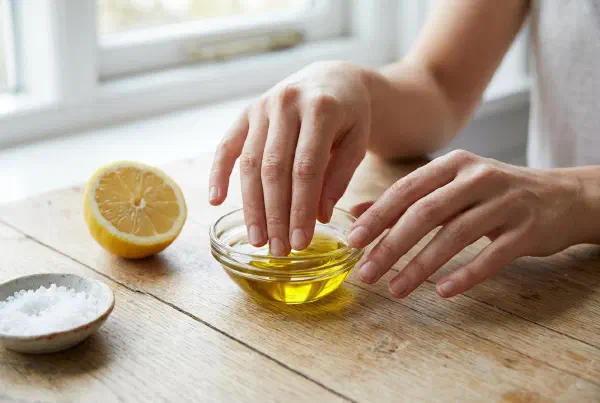
- Massage in nail oil daily: A rich oil (such as almond, jojoba, or olive oil) nourishes the nail and cuticle. Massage it into the nail fold in the evening.
- Wear gloves: When washing dishes and cleaning, rubber gloves protect against water and chemicals. In winter, gloves keep hands warm and moist-elastic.
- Remove gently: Use an acetone-free nail polish remover and give your nails polish-free days in between.
- File correctly: Use a fine file (at least 240 grit) and file in one direction only – never back and forth. Never file wet nails, because they are especially soft then.
- Don’t clip: A clipper crushes the nail and encourages splitting. Better to shorten it with a file.
If your nails are additionally strained by polish, it is worth looking at the right application – in our article Make Nail Polish Last Longer: 10 Tricks Against Chipping you will find tips that also protect the nail itself.
Which Nail Shape Helps?
The shape makes a difference too. Pointed nails break more easily at the narrow corners. A round or oval shape distributes the strain more evenly and is usually more robust for brittle nails. Which shape suits you is shown in the overview Nail Shapes at a Glance: Oval, Almond, Square and More.
Care From the Inside: Nutrition for Firm Nails
Since the nail is supplied through the root, firmness develops long before it becomes visible. A balanced diet is therefore the foundation. These building blocks are particularly relevant:
- Protein: Keratin is a protein. Eggs, legumes, fish, dairy products, and lean meat provide the building blocks.
- Biotin: This B vitamin is considered the classic nail and hair nutrient and is found in egg yolk, nuts, and oats.
- Iron: An iron deficiency often shows up in brittle, dented nails. Good sources are legumes, whole grains, and green vegetables, combined with vitamin C for absorption.
- Zinc: Important for cell formation – found in pumpkin seeds, cheese, and whole grain products.
- Drink enough: The nail also benefits from a well-supplied body.
Dietary supplements can be useful if there is actually a proven deficiency. Supplementing in high doses on the off chance usually does little – a targeted blood test when a deficiency is suspected is the better way.
What to Avoid
Some well-meant measures do more harm than good:
- Using hardening nail hardeners long term: Hardeners high in formaldehyde can make nails appear firmer in the short term but make them brittle over time. Use them only as a short treatment course at most.
- Artificial nails as a permanent solution: Gel and acrylic cover up the problem and can further weaken the natural nail when removed. The damp climate that forms underneath also makes it important to recognise and treat nail fungus early before it can spread.
- Cutting away the cuticle: The cuticle is a protective barrier. Gently push it back instead of cutting it off.
Patience as the Most Important Ingredient
A fingernail only fully renews itself after several months. Even if you start with the perfect routine today, the already damaged part only grows out slowly. So stay with it: daily oiling, gentle filing, and a nutrient-rich diet gradually pay off with firmer, less splitting nails.
Frequently Asked Questions (FAQ)
How long does it take for brittle nails to get better? Since fingernails grow only about 2 to 3 millimeters per month, you need patience. You often see the first improvements in the cuticle and shine after a few weeks, but a fully regrown, healthier nail takes three to six months.
Does biotin really help against brittle nails? Biotin is considered an important nutrient for nails and can help if there is a deficiency. If there is no deficiency, the effect of taking it additionally is usually small. A balanced diet is the more reliable foundation.
Are water and dish soap to blame for my brittle nails? Frequent contact with water and cleaning agents is one of the main causes, because the nail constantly swells and dries out again. Gloves when washing dishes and cleaning, as well as regular oiling, are the most effective measures here.
When should I see a doctor about brittle nails? If your nails remain brittle for months despite consistent care, or if discoloration, deformation, or pain also occurs, you should have it checked by a doctor. Nutrient deficiencies or other health causes may be behind it.