How to File Nails Correctly: The Right Technique Without Tears
In this article
Note: This article contains affiliate/advertising links. As an Amazon Associate we earn from qualifying purchases. If you click such a link and buy something, we may receive a small commission – at no extra cost to you.
Filing nails sounds simple, but this is exactly where it is decided whether your nail edges stay smooth and stable or whether tears and splinters form. The right filing direction, the right grit, and a few simple techniques make the difference between a clean manicure and brittle, frayed edges. In this guide you will learn how to gently shape your nails and which mistakes are best avoided.
Why the Filing Direction Is So Important
The most common mistake when filing is the sawing motion: many people move the file back and forth as if they were working a piece of wood. That is exactly what damages your nails. The nail plate consists of several layers lying on top of each other, built up like puff pastry. If you saw back and forth, these layers loosen at the edge, split, and tear.
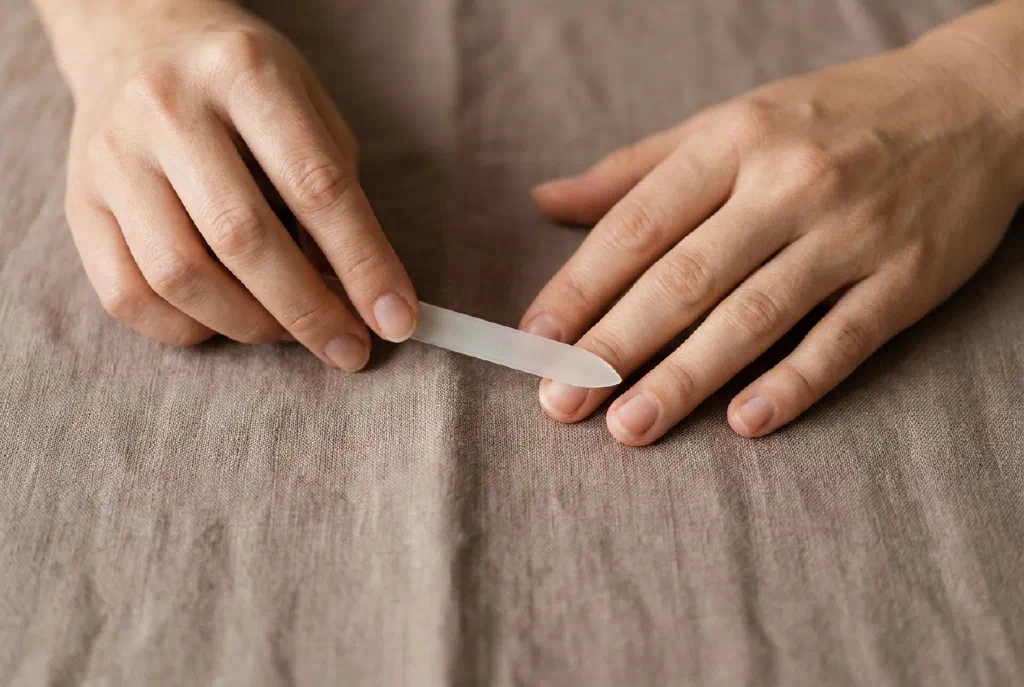
Instead, always file in one direction – from the outer corner toward the center of the nail. Place the file, draw it in a smooth stroke toward the center of the nail, and then lift it off before starting again. This keeps the layers of the nail plate sealed and the edge becomes smooth.
Step by Step
- Start at the right outer corner and file toward the center.
- Repeat the same from the left corner toward the center.
- Work with light, even pressure rather than force.
- Check the shape regularly against the light.
Choosing the Right Grit
Files are rated in grits – the lower the number, the coarser the file. A coarse file with 80 or 100 grit belongs exclusively to artificial nails or gel. For your natural nails it is far too aggressive and literally tears the edges open.
For natural nails the following applies:
- 180 grit: Ideal for shortening and shaping natural nails.
- 240 grit: For finely smoothing the edge after shaping.
- Polishing or buffer file: Seals the edge and makes it supple.
Avoid the classic metal files with a coarse, stamped surface. They create small cracks in the edge. Reach instead for a glass or sandpaper file, which works more finely and more gently. A glass file also has the advantage that it can be washed off and keeps its grit for a long time. In the salon, by the way, pros often work with an electric e-file instead of a hand file – you can read how precisely this professional e-file technique is used in a Russian manicure in our dedicated guide.
File Dry – Never After a Bath
A crucial point: always file your nails when they are dry. After a bath or prolonged hand washing, the nail plate soaks up water and becomes soft. Soft nails fray heavily during filing and then dry out again with rough, unstable edges.
Therefore plan filing before the manicure, or wait at least half an hour after showering. This way the nail plate is firm and can be shaped precisely.
Finding the Right Nail Shape
The ideal shape depends on your natural nail bed shape. Anyone who quickly struggles with tears is usually better served with a round or oval shape, since it has no sensitive corners. Square shapes like square look elegant but are more prone to breakage at the side corners.
- Round: Stable and everyday-friendly, ideal for short nails.
- Oval: Visually lengthening, little prone to tears.
- Square: Modern, but sensitive corners.
- Squoval: A compromise between square and round, very popular.
Do not file the side edges in too much. Anyone who files the sides too deeply weakens the nail’s natural support structure, which makes it tear more easily.
Common Mistakes When Filing
Even with the right file, mistakes can quickly creep in. You should know these:
- Too much pressure: If you press the file down hard, the edge overheats and frays.
- Wrong angle: Hold the file slightly angled from below, not flat against the edge.
- Too hasty: A few controlled strokes achieve more than fast scrubbing.
- Forgetting the polishing finish: A briefly sealed edge tears noticeably less often.
To finish, a gentle stroke with the buffer file over the cut edge is worthwhile. This seals the layers and gives the edge a smooth finish. Afterwards it is best to apply a nourishing nail oil to keep the nail plate supple.
If you like the clean preparation, you can then get creative afterwards – for example with Dip Powder Nails: how the powder technique works at home or with simple patterns from the guide Nail Art for Beginners: easy designs with few tools. A smooth, filed edge is always the foundation for a clean result.
If you notice recurring tears, discoloration, or deformation of the nails, have it checked by a doctor when in doubt, as it can also be due to a nutrient deficiency or an illness.
Frequently Asked Questions (FAQ)
In which direction should I file my nails? Always file in one direction, from the outer corner toward the center of the nail. The sawing back-and-forth motion loosens the nail layers and leads to tears and splinters.
Which grit is right for natural nails? For natural nails, a fine file with 180 grit is suitable for shaping and 240 grit for smoothing. Coarse files below 150 grit are intended only for artificial nails and gel.
Can I file my nails after showering? No, better not. After bathing, the nail plate is soft and frays heavily during filing. Wait at least half an hour until the nails are dry and firm again.
Why do my nails keep splitting despite filing? Common causes are a coarse metal file, too much pressure, or a sawing motion. Switch to a glass file, file in one direction, and seal the edge with a buffer file.