Make Your Own Nail Oil: Recipes for Stronger Nails
In this article
Note: This article contains affiliate/advertising links. As an Amazon Associate we earn from qualifying purchases. If you click such a link and buy something, we may receive a small commission – at no extra cost to you.
Nail oil is the most unremarkable product on the manicure table and at the same time the one that makes the biggest difference. The catch: ready-made bottles quickly cost ten euros, yet they often contain nothing but two or three plant oils you can buy at the pharmacy. Mixing your own takes five minutes, costs a fraction of that, and you know exactly what’s in it. Here you’ll learn which oils are worth using, what three tested recipes look like and what to watch out for with essential oils.
Why Nail Oil Works
A fingernail consists of keratinised, dead cells. It is formed in the nail matrix, the growth zone beneath the nail wall. What you see on top can no longer be repaired, but it can be kept supple.
That’s exactly where oil comes in, in two places. It supplies the cuticle and nail wall around the matrix with lipids, and dry skin there is the reason for hangnails and torn edges. It also forms a thin film on the nail plate and slows down moisture loss. A nail with enough water content is more elastic and splits less.
What oil cannot do: it does not speed up growth, since the roughly three millimetres a month are set by your body. And it does not treat nail fungus. If nails look yellowish, crumbly or thickened, that belongs in a doctor’s hands, more on this under Recognising and Treating Nail Fungus.
The Right Oils and Why
What counts is absorption behaviour, fatty acid profile and shelf life.
- Jojoba oil (base no. 1): strictly speaking a liquid wax whose structure closely resembles sebum. It therefore absorbs exceptionally well, leaves almost no greasy film and barely goes rancid. If only one oil, then this one.
- Almond oil: inexpensive, mild, well tolerated, a classic for sensitive skin. Absorbs more slowly than jojoba. Careful with nut allergies.
- Avocado oil: heavy and rich, ideal for cracked nail edges in winter. Feels noticeably greasy in a high proportion, so blend it in rather than using it neat.
- Argan oil: rich in vitamin E, pleasantly light, but expensive. A touch of luxury, not a must.
- Wheat germ oil: the natural vitamin E supplier; a share of around 10 per cent also keeps the blend fresh for longer. Neat it is too viscous and strong in smell. It contains gluten.
Steer clear of mineral oil (paraffin) as the sole base, it only sits on top. Kitchen olive oil works in a pinch, but it smells intense and stays greasy for a long time.
Essential Oils: Sparingly and Sensibly
Essential oils are highly concentrated. For skin, an upper limit of 1 to 2 per cent applies, so 2 to 4 drops per 10 ml of carrier oil. More brings no benefit but does irritate. Proven choices are tea tree oil and lavender oil. Important:
- Never neat on the skin, always in a carrier oil.
- During pregnancy and breastfeeding as well as with small children, better to leave them out.
- With an allergy or sensitive skin, test on the crook of your arm first and wait 24 hours.
- Stop using it if redness, burning or itching occurs.
A fragrance-free nail oil is the safest option and cares just as well.
Three Recipes with Exact Amounts
All recipes for a 10 ml bottle: pour in, close, roll between your palms, done.
1. The all-rounder (for every day)
- 8 ml jojoba oil
- 2 ml almond oil
- optionally 2 drops lavender oil
2. The winter treatment (for cracked nail edges)
- 5 ml jojoba oil
- 3 ml avocado oil
- 1 ml wheat germ oil
- 1 ml almond oil
Rich, slow to absorb, ideal in the evening as overnight care.
3. The clarifying oil (for frequent artificial nail wearers)
- 8 ml jojoba oil
- 1.5 ml argan oil
- 0.5 ml wheat germ oil
- 2 drops tea tree oil
For anyone who often wears gel and wants to keep the natural nail underneath supple. How to nurse it back after a break is explained in Rebuilding the Natural Nail After Gel.
Bottling and Storage
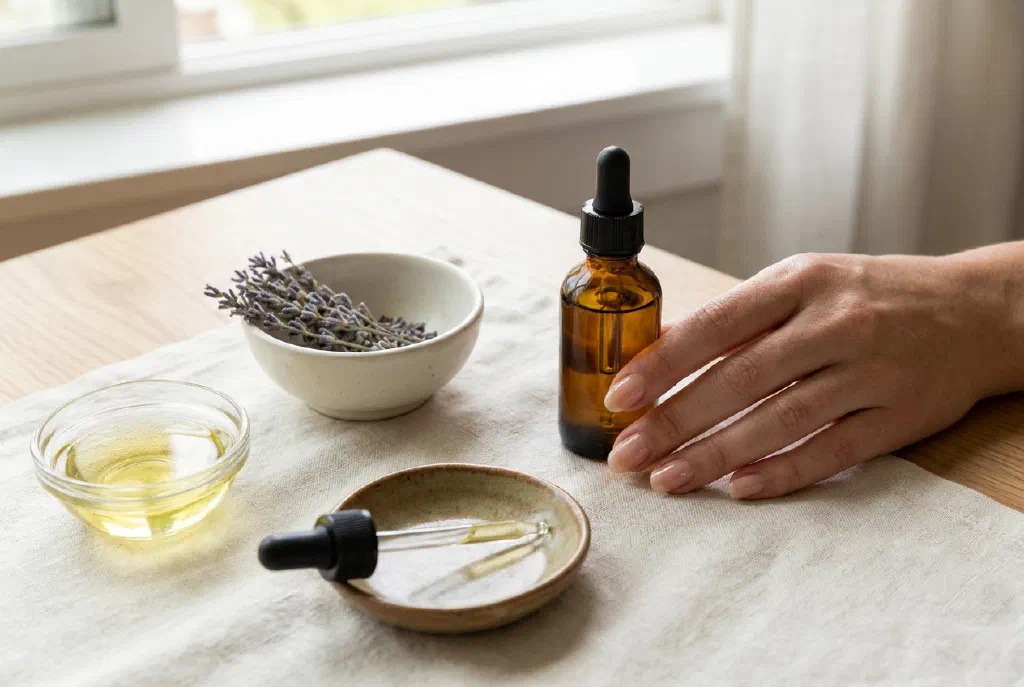
Take a bottle of dark glass, because light makes plant oils go rancid faster. The dropper doses precisely at home, the roll-on doesn’t spill on the go. Store it cool and dark, not on the bathroom windowsill. Shelf life: about three to six months, rather at the upper end with plenty of jojoba oil. The nose decides, because rancid oil smells sharp and old and irritates the skin instead of caring for it. So mix small amounts.
Using It Properly
- Once or twice a day, put a drop on each nail edge and massage it in. The massage spreads the oil right under the nail wall.
- Preferably in the evening, because it then works for hours.
- After washing your hands a drop, or hand cream as an alternative.
- Not before polishing. Oil on the nail plate is the most reliable way to make polish chip after two days. The nail is degreased beforehand; the oil goes on the nail edge only after the top coat. More on this under Make Nail Polish Last Longer.
Oil alone is only one building block: how to gently push back the cuticle is shown in Caring for Your Cuticles Properly, and further approaches for splitting nails can be found under Strengthening Nails with Home Remedies.
Common Mistakes
- Too much essential oil: more does not help more here; it irritates.
- Mixing too large a batch: the oil goes rancid before the bottle is empty.
- Clear glass or plastic: light and oxygen speed up spoilage.
- Oil before polishing: the polish won’t hold.
- Applying irregularly: a daily drop beats every expensive treatment.
Conclusion
Jojoba oil as the base, a splash of almond or avocado oil, a little wheat germ oil for vitamin E, done. Essential oils are optional, and if used, then at most two to four drops per 10 ml. In dark glass, stored cool and applied daily, it keeps the cuticle and nail plate supple, which means your nails split less.
Frequently Asked Questions (FAQ)
Does nail oil make nails grow faster?
No. The growth rate of about three millimetres a month is determined in the nail matrix and cannot be accelerated from the outside. Oil does keep the nail more supple, however, so it breaks off less often, and as a result it often gets longer in everyday life without growing any faster.
How long does homemade nail oil keep?
About three to six months if you store it cool, dark and in dark glass. Blends with a high jojoba share keep longer. If the oil smells sharp or old, it has gone rancid and belongs in the bin.
Can I just use olive oil from the kitchen?
At a pinch, yes, it does no harm. Olive oil absorbs considerably more slowly, though, leaves a greasy film and smells strong. Jojoba or almond oil are more pleasant and hardly cost more in small amounts.
Does nail oil with tea tree oil help against nail fungus?
No, you shouldn’t rely on that. Homemade nail oil is a care product, not a medicine. With yellowish, crumbly or thickened nails, have the cause checked by a doctor instead of experimenting on your own for months.