Nail extensions: all methods at a glance
In this article
Note: This article contains affiliate/advertising links. As an Amazon Associate we earn from qualifying purchases. If you click such a link and buy something, we may receive a small commission – at no extra cost to you.
You dream of long, even nails, but your natural nails break, split or simply refuse to grow the way you want? Then nail extensions are the answer – and the choice has never been bigger. Whether gel sculpting, acrylic, polygel, soft gel tips or press-on nails: every method has its strengths, its typical effort and its ideal audience. In this overview you will get to know all the common methods for artificial nails, see their pros and cons in a comparison table and find out which option fits your everyday life, your time budget and your nails.
Why get nail extensions?
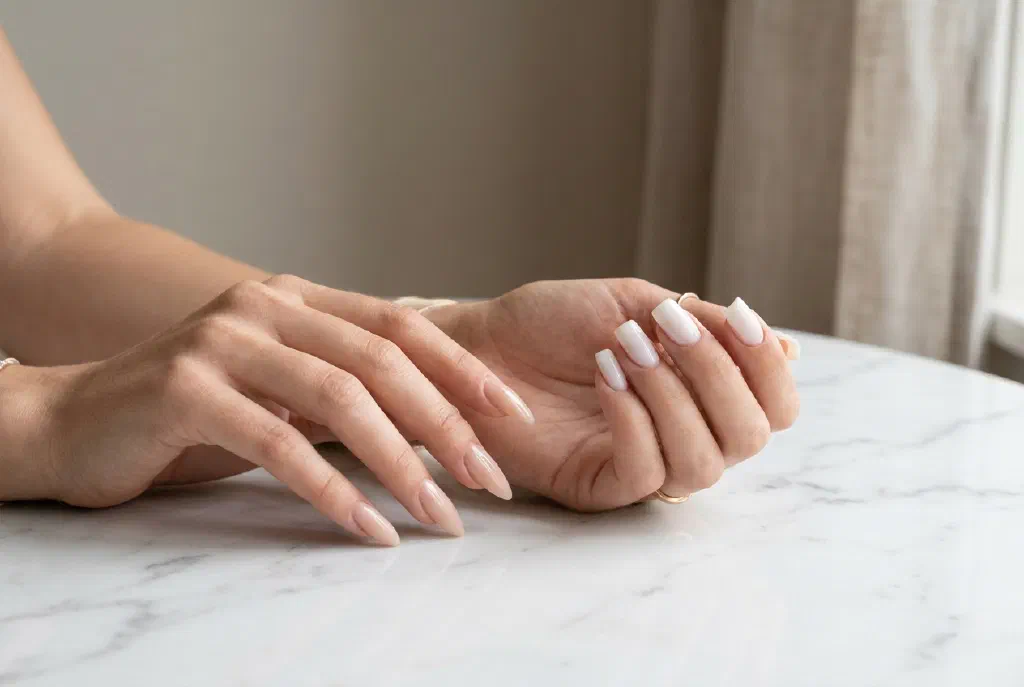
Nail extensions do more than lengthen the visible nail – they change the whole hand: fingers look slimmer, you can choose any nail shape you like, and brittle natural nails get a protective layer. That is exactly why so many people turn to artificial nails – not out of vanity, but because short or soft nails simply cannot carry many designs.
Typical reasons for extensions:
- Brittle or soft nails: The artificial layer stabilizes the nail and protects it from bending and snapping in everyday life.
- Your dream shape: Whether almond, squoval or stiletto – with extensions, all nail shapes are possible, regardless of your natural nail.
- An even result: Ten identically long, identically shaped nails instantly look polished.
- A canvas for nail art: Long nails offer more surface for French tips, chrome or elaborate designs.
Which method is the right one depends on durability, effort and your experience – so let us look at the candidates one by one.
Gel sculpting: the classic with forms or tips
Gel sculpting is the best-known salon method. A viscous UV gel is sculpted over a paper form or onto glued-on tips and cured under a UV/LED lamp. The result is a slightly flexible, glossy nail that feels natural and lasts three to four weeks before it needs an infill. Gel forgives small mistakes during application, has hardly any smell and files easily. In return, the build-up takes time and removal is done by filing. With a bit of practice you can sculpt at home too – you will find a detailed guide under doing gel nails yourself.
Acrylic nails: tough and shape-stable
With acrylic, the nail technician mixes a powder (polymer) with a liquid (monomer) and sculpts the nail from it, which hardens in the air – no lamp needed. Acrylic nails are especially hard and hold their shape, ideal for long lengths and pointed shapes like stiletto. However, the monomer’s smell is intense, the technique demands fast, precise work, and preparation and removal put more strain on the natural nail. You can read how the technique works step by step under doing acrylic nails yourself – and whether gel or acrylic suits you better is covered in the comparison acrylic or gel.
Polygel: the blend of gel and acrylic
Polygel combines the best of both worlds: the mass is firm like acrylic but, like gel, only cures under the lamp. Nothing runs, and you can sculpt at your own pace – perfect if you want to take your time shaping. Polygel is lighter than acrylic, sturdier than many gels and almost odorless. It is applied with a spatula and brush over forms or dual forms. For beginners with a little patience, polygel is one of the most forgiving salon methods for home use. You will find all the details, tools and the exact technique in the article on polygel nails.
BIAB and builder gel: strengthening instead of lengthening
BIAB (“Builder in a Bottle”) is a building gel in a polish bottle that is brushed on like nail polish and cured under the lamp. Strictly speaking it is not a classic extension but a strengthener: the natural nail gets a stable, flexible protective layer and can grow long underneath it. Small extensions are possible with a form, but BIAB’s strength lies in its natural look and its gentle, quick application. Ideal for anyone who wants to grow out their own nails. You can learn more in the article on BIAB nails and builder gel.
Gel-X and soft gel tips: the fast full-cover method
With Gel-X and soft gel tips, a pre-shaped, full-cover artificial nail made of soft gel is attached to the natural nail with a special adhesive gel and fixed under the lamp. Nothing is sculpted – length and shape are already set, you simply pick the matching tip size. That makes the method fast, even and comparatively beginner-friendly. The tips can later be soaked off in an acetone bath, which is gentle on the natural nail. Depending on the prep, they last two to four weeks. Perfect if you want a salon look without elaborate sculpting.
Press-on nails: extensions you glue on
Press-ons are ready-made artificial nails that you simply press on with adhesive pads or nail glue – no lamp, no filing marathon, no chemistry skills required. They are the fastest and gentlest form of nail extension: a complete set is on within minutes, and with pads they come off again without residue. In return they only last a few days up to about two weeks, depending on the adhesive and your daily routine. For beginners, special occasions or a spontaneous change of look they are unbeatable. The guide on applying press-on nails properly shows you how to make them last.
Dip powder: extensions with dipping powder
With the dip powder system, the nail is coated with a base adhesive and dipped into fine colored powder – layer by layer until the desired strength is reached. An activator hardens everything without a lamp. Combined with tips, an extension is possible too. Dip nails are surprisingly tough, last three to four weeks and work well at home with a bit of practice. The key is working cleanly in thin layers so the result does not get too thick. You will find a step-by-step explanation in the dip powder guide.
Comparison table: all methods at a glance
| Method | Durability | Effort | Gentle on natural nails | Beginner-friendly |
|---|---|---|---|---|
| Gel sculpting | three to four weeks | high | medium | with reservations |
| Acrylic | three to four weeks | high | rather low | rather not |
| Polygel | three to four weeks | medium | medium | yes, with practice |
| BIAB/builder gel | two to four weeks | low to medium | high | yes |
| Gel-X/soft gel tips | two to four weeks | medium | high | yes |
| Press-on nails | days up to two weeks | very low | very high | yes |
| Dip powder | three to four weeks | medium | medium | yes, with practice |
These figures are rough guides: preparation, product quality and your daily routine noticeably influence how long each method lasts.
Which method suits you?
The best nail extension is the one that fits your life – not the one with the longest wear time. A few rules of thumb:
- You want it instant and easy: Press-ons. No device, no practice, no waiting – and your natural nail stays untouched.
- You want a salon look without sculpting: Gel-X/soft gel tips deliver even length in little time and can be removed gently.
- You want to grow your natural nails long: BIAB strengthens instead of lengthening and supports your nails as they grow.
- You want to learn sculpting at home: Polygel is the most forgiving, followed by gel. Dip powder is a good lamp-free alternative.
- You want maximum length and hardness: Acrylic at the salon is the first choice for dramatic shapes – the differences are explained in the comparison acrylic or gel.
- You are unsure about the shape: Choose the method first, then the shape – the overview of nail shapes helps you decide.
Care and infills
Whichever method you choose: artificial nails need care so they stay beautiful and your natural nail stays healthy.
- Infills: With gel, acrylic, polygel and dip, the nail grows out and a gap appears at the base. Every two to four weeks the regrowth is filled in – this keeps the structure balanced so nothing breaks off. Book these in good time, because a nail salon without an appointment rarely fits in an infill on the spot.
- Cuticle oil: Daily oiling keeps cuticles and natural nails supple and prevents dry edges.
- No prying: Artificial nails are jewelry, not tools. Better find another way to open that can.
- Gentle removal: Never rip or pick them off – soft gel and dip are soaked off in an acetone bath, hard gels are filed off. When in doubt, let the salon do it.
- Breaks are not a must: More important than “nail breaks” is clean, gentle removal and good care between appointments.
Frequently asked questions (FAQ)
Which nail extension lasts the longest?
Acrylic, gel sculpting, polygel and dip powder last the longest at three to four weeks – then it is time for an infill. Gel-X follows closely behind, while press-ons, at a few days up to two weeks, are the shortest-lived but most flexible solution.
Which method is gentlest on the natural nail?
Press-ons with adhesive pads, because they need no buffing and no curing at all. Next come soft gel tips and BIAB, which can be soaked off in an acetone bath. With every method, gentle removal is what matters most – ripping them off always causes damage.
What is the difference between an extension and an overlay?
An extension builds additional length beyond the nail tip, for example with a form or tips. An overlay such as BIAB only adds a stable layer on top of the natural nail so it can grow long on its own.
Which nail extension is suitable for beginners?
Press-ons are the easiest entry point, followed by soft gel tips. If you want to learn sculpting, polygel is the best place to start, because the mass does not run and you can take your time shaping.
How often do artificial nails need an infill?
As a rule every two to four weeks, depending on how fast your nails grow. During an infill the grown-out base is filled in and the shape is corrected – this preserves both stability and looks.
Can I wear extensions with brittle nails?
Yes, soft and brittle nails in particular often benefit from the stabilizing layer. A gentle method such as BIAB, soft gel tips or a thinly worked gel sculpt makes sense – combined with consistent cuticle oil care.