Russian manicure: the dry manicure with the ultra-clean finish
In this article
Note: This article contains affiliate/advertising links. As an Amazon Associate we earn from qualifying purchases. If you click such a link and buy something, we may receive a small commission – at no extra cost to you.
The Russian manicure is the manicure technique everyone is talking about right now – and the reason some nails look so incredibly “clean” in photos. Instead of a water bath and a cuticle pusher, a fine electric file does the work here: the cuticle is treated dry, precisely and with millimeter accuracy, so the polish later reaches right up to the skin. In this article you will learn what the Russian manicure really is, how it differs from a classic manicure, what the salon routine looks like, why the result appears so flawless – and what to look out for when it comes to safety and hygiene.
What is a Russian manicure?
The Russian manicure – also called a dry manicure or e-file manicure – is a technique in which the cuticle is not soaked but worked on dry with an electric nail drill. The name goes back to the fact that the method was perfected in Eastern European salons before social media made it famous worldwide.
The heart of the technique is the e-file with its various attachments (bits): a pointed, flame-shaped bit opens and lifts the cuticle, then a ball-shaped bit removes the fine layer of dead skin on the nail plate – the so-called pterygium. What remains is a completely exposed, smooth nail without any skin remnants or ragged edges. The cuticle itself is not cut away wholesale but reduced deliberately and sparingly – it keeps its protective function while looking noticeably tidier. You can read more about why this balance matters in our guide to proper cuticle care.
How it differs from a classic manicure
In a classic manicure, the hands are first soaked in water, the cuticle is pushed back with a pusher and any excess skin is trimmed with nippers or scissors. That works well, but it has two drawbacks: softened skin is hard to cut precisely, and the nail absorbs moisture in the water bath – polish or gel adheres less well afterwards.
The Russian manicure turns the principle around:
- Dry instead of wet: Without soaking, the skin stays firm and can be worked on exactly. The nail keeps its natural shape and adhesion surface.
- E-file instead of pusher: The rotating bits work more finely than any hand tool and reach even the side walls of the nail.
- More precision, more time: A Russian manicure takes noticeably longer than a classic treatment – but the result usually stays fresh longer too, because the cuticle grows back more slowly and the polish sits closer to the skin.
If you want to know how the classic version works at home, here is a step-by-step manicure guide.
The salon routine: step by step
This is what a typical Russian manicure at the salon looks like:
- Preparation: Hands and workspace are disinfected, and old polish or gel polish is removed.
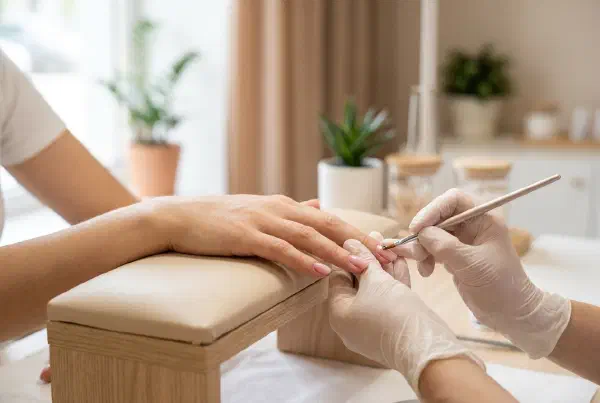
- Opening the cuticle: Using a fine, flame-shaped bit, the nail technician works under the edge of the cuticle and gently releases it from the nail plate.
- Lifting and pushing back: The loosened cuticle is lifted so that the border between skin and nail becomes clearly visible.
- Removing the pterygium: A ball-shaped bit takes off the thin layer of dead skin on the nail plate – the area under the cuticle becomes completely clean.
- Fine detailing: Excess, loose bits of skin are trimmed precisely with fine scissors – only as much as necessary.
- Shaping: The nail gets its shape. Our article on filing nails in the right direction explains how to avoid splitting.
- Polishing right up to the skin: Gel polish or polish is applied in wafer-thin layers so close to the pushed-back cuticle that practically no bare margin remains visible.
- Finishing care: Finally, nail oil is applied to the cuticle to keep the freshly treated skin supple.
Why does the result look so “clean”?
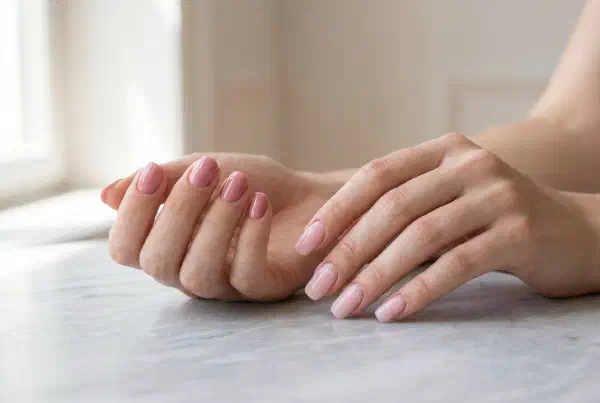
The secret of the famous finish lies in two details. First: because the cuticle is fully lifted and the area beneath it is exposed, the color can be placed right under the edge of the skin. There is no unpainted strip at the base of the nail – which makes the nail look longer and seamless. Second: no skin remnants or flakes are left on the nail plate where the polish could lift or settle unevenly. The result looks polished and still appears tidy after two to three weeks, because regrowth becomes visible later than with a manicure that leaves a visible gap to the cuticle.
Safety and hygiene: what matters
The Russian manicure is a demanding technique – and that is exactly why it belongs in trained hands. Looked at objectively, there are a few points to pay attention to:
- The nail technician’s training: The e-file works right at the border between nail and skin. If it is applied at the wrong angle, held too long in one spot or used with too much pressure, it can thin the nail plate, generate heat or injure the skin. An experienced professional works with fine bits, low speed and no pressure – then the treatment is comfortable and pain-free.
- Salon hygiene: Since the work happens directly at the cuticle, the e-file bits must be cleaned and sterilized after every client, ideally in an autoclave. A reputable salon will answer questions about how its tools are processed openly – do not hesitate to ask.
- Not overdoing it: The cuticle has a protective function. Good salons remove only the dead skin layer and loose bits, not the living skin. Treatments that are too frequent or too aggressive are counterproductive.
So there is no reason to worry – but every reason to choose your salon deliberately and not to experiment with the e-file yourself without practice. If you are dropping into a nail salon without an appointment, a classic manicure or gel polish is usually the better pick.
Who is the Russian manicure suitable for?
The technique is especially worthwhile for you if you wear gel polish or shellac and want to get the maximum in durability and looks, if your cuticles grow back quickly and classic manicures never stay tidy for long on you, or if you want a particularly flawless result for a special occasion. It is less suitable if your cuticles are inflamed or injured, or if your nail plate is already heavily stressed and thinned – in that case a gentle care phase is the better choice before working with the e-file again.
Aftercare following a Russian manicure
After the treatment, the cuticle has been freshly worked on and needs attention so that it stays supple and does not tear:
- Nail oil daily: One or two drops of nail oil, gently massaged in, keep the cuticle and nail edges elastic. You can also mix your own nail oil.
- Do not forget hand cream: Especially after the dry treatment, the skin appreciates extra moisture.
- No picking: Small regrowing bits of skin get oiled and dealt with at the next appointment – not torn off.
- Find a rhythm: Most people have their Russian manicure refreshed every three to four weeks, often combined with a fresh gel polish application.
Frequently asked questions (FAQ)
What exactly is a Russian manicure?
A dry manicure in which the cuticle is treated without a water bath, using an electric file with various bits. The cuticle is lifted, the dead skin layer on the nail plate is removed, and the polish is then applied right up to the skin.
Does a Russian manicure hurt?
Not when performed properly. A trained nail technician works with fine bits, low speed and no pressure. If you feel pain or strong heat, say so immediately – it is a sign that the work is too intense.
Why does a Russian manicure stay tidy longer than a classic manicure?
Because the cuticle is fully pushed back and the polish starts directly at the skin, regrowth becomes noticeable later. In addition, no skin remnants remain on the nail plate where the polish could lift.
How often should you get a Russian manicure?
A rhythm of about three to four weeks is common, often together with the next gel polish appointment. More frequent treatments are unnecessary and put needless strain on the cuticle.
Is the Russian manicure bad for the nails?
With trained application and sterilized bits it is a precise, gentle technique. Risks arise mainly from improper e-file use – such as too much pressure or bits that are too coarse. So choose a salon that is experienced with the technique and speaks openly about its hygiene.
Can I do a Russian manicure myself?
Working with the e-file directly at the cuticle requires a lot of practice and a steady hand – for beginners, the salon is the better choice. At home you can achieve a similarly well-groomed result with a gentle classic manicure and good cuticle care.