The Five Tibetans: the five exercises step by step
In this article
Note: This article contains affiliate/advertising links. As an Amazon Associate we earn from qualifying purchases. If you click such a link and buy something, we may receive a small commission – at no extra cost to you.
The Five Tibetans are a short, flowing routine of five movements that many people value as a morning ritual for more mobility, energy and a wide-awake sense of the body. The big appeal: they take only a few minutes, need no equipment and can be done anywhere on a mat. In this guide you get a brief look at the origins and, above all, the five exercises step by step – with breathing, repetitions and a gentle beginner variation for each movement.
What the Five Tibetans are
The Five Tibetans are a sequence of five repeated movements that are now practised worldwide as a wellness and movement routine. They became known in the 20th century through a slim little book that attributed the exercises to old knowledge from Tibetan monasteries. That origin is regarded more as myth and story than as documented tradition – but as a gentle movement routine, the five exercises have long since established themselves.
At their core, the Five Tibetans are a mix of turning, bending and stretching movements done one after another. Unlike a long workout, they are deliberately kept short and are meant above all to be performed evenly and calmly. If flowing movement appeals to you, you will find related approaches in gentle Qigong and slow Tai Chi, which likewise combine breathing and movement. A similarly flowing sequence is the sun salutation yoga sequence step by step.
The five exercises step by step
Lay out a mat, put on comfortable clothing and practise barefoot. Breathe calmly throughout, without forcing. The following order is fixed.
Exercise 1: spinning while standing
- Stand upright, arms stretched out to the sides at shoulder height, palms facing down.
- Turn on the spot clockwise around your own axis, with a calm gaze straight ahead.
- Breathing: keep it even, do not hold it.
- Beginner variation: few turns, slow pace – stop at once if you feel dizzy and fix your eyes on a steady point.
Exercise 2: lifting the legs and head
- Lie on your back, arms beside the body, palms on the floor.
- As you inhale, lift your head and your straight legs, chin towards the chest, legs as vertical as possible.
- As you exhale, lower both slowly and with control again.
- Beginner variation: bend the knees slightly so the lower back stays relieved.
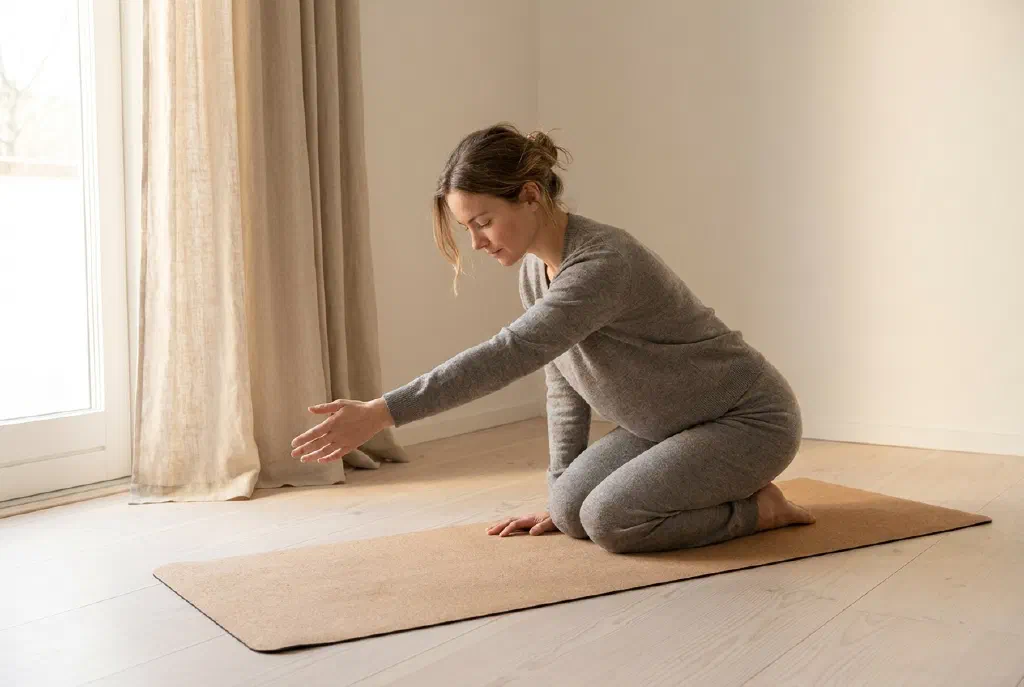
Exercise 3: kneeling with a gentle back bend
- Kneel upright, toes tucked under, hands on the back of the thighs.
- As you inhale, open the chest and tilt the upper body gently backwards.
- As you exhale, return upright to the centre.
- Beginner variation: only a small movement backwards – keep the neck long and do not crank it back.
Exercise 4: the tabletop position
- Sit with your legs long, hands flat beside the hips, fingers pointing forward.
- As you inhale, lift the hips until torso and thighs form a horizontal line, the head following in a relaxed way.
- As you exhale, lower the hips back into the seat.
- Beginner variation: raise the hips only slightly and hold briefly instead of going all the way to horizontal.
Exercise 5: mountain and dog
- Support yourself on hands and feet, the body forming an inverted V (the “mountain peak” image).
- As you inhale, let the hips sink so the upper body opens forwards and upwards.
- As you exhale, push the hips back up into the inverted V.
- Beginner variation: bend the knees slightly so shoulders and lower back stay loose.
How and when to practise
Many do the Five Tibetans first thing in the morning, because the routine starts the day awake and mobile. But you can just as easily do them during the day or in the early evening – what matters is regularity, not the time of day. If you would rather wind the day down calmly, the movement pairs well in the evening with autogenic training for beginners.
Classically you start with three repetitions per exercise and increase gently. A proven rule of thumb:
- Week 1: 3 repetitions each.
- After that add 2 per week, until you reach about 21 repetitions each.
- Listen to your body: increase slowly rather than abruptly – the movement should stay clean all the way through.
That way the routine stays doable in a few minutes even at 21 repetitions. If you are looking to ease into regular movement, many people combine the Five Tibetans with calm yoga for beginners or loosen tense areas afterwards with targeted foam roller exercises.
Tips and what to watch out for
- Clean before fast: a calm, controlled movement does more than many hasty repetitions.
- Back and neck gently: in the back bends keep the neck long and go only as far as stays comfortable – never crank it back or force it.
- Let the breath lead: if you lose your way, return to even breathing and match the pace to it.
- Mind dizziness: the first exercise in particular can feel slightly dizzying at first – then do few turns, fix your eyes on a steady point and increase slowly.
- Surface: a non-slip mat gives you grip, especially in the tabletop and mountain positions.
With acute complaints in the back, neck, knees or joints, during pregnancy or with circulatory issues, it is best to check with a doctor before practising. The Five Tibetans are a movement routine for your wellbeing, not a substitute for medical advice or treatment.
Who the Five Tibetans suit
The routine works well if you are after a short, fixed movement routine that needs no equipment and slots easily into everyday life. Anyone who finds it hard to get going in the morning will also appreciate the compact sequence. Thanks to the beginner variations, the start can be adapted to your own mobility – you do not have to be flexible to begin; you tend to become so over time.
The routine is less suited as a replacement for targeted strength training or as a rehab programme for existing complaints. Here you are better off adding suitable options and seeking professional guidance where needed.
Frequently asked questions (FAQ)
How many Five Tibetans should I do at the start?
Start with three repetitions per exercise. That is enough to learn the movements cleanly without overdoing it. Only once the sequence feels smooth do you increase slowly – classically by two per week, up to about 21 repetitions per exercise.
How long does one round take?
In the beginner phase with three repetitions each you are through in a few minutes. Even at the full progression of 21 repetitions, the complete routine usually stays under a quarter of an hour if you practise calmly and evenly.
Do I have to be flexible to start?
No. For each of the five exercises there is a gentler variation, such as bent knees or a smaller movement backwards. You only go as far as stays comfortable, and you usually gain mobility over time.
When is the best time to practise?
Many prefer the morning, because the routine brings you into the day awake. But what counts is that you practise regularly – pick the time when you can reliably fit it into everyday life.
What do I do if I feel dizzy or have complaints?
If you feel dizzy, especially from the first spinning exercise, reduce the repetitions and fix your eyes on a steady point while turning. If you feel pain in the back, neck or joints, do not push further into the movement and have persistent complaints checked by a doctor.