Autogenic training: exercises and a beginner's guide

In this article
Note: This article contains affiliate/advertising links. As an Amazon Associate we earn from qualifying purchases. If you click such a link and buy something, we may receive a small commission – at no extra cost to you.
Autogenic training is one of the best-known relaxation methods in the German-speaking world – and it is especially accessible for beginners, because all you need is a few quiet minutes. You guide your relaxation through short, calm sentences that you say to yourself internally. It sounds simple, yet it works surprisingly deeply. In this guide you get the six standard exercises explained step by step, with example phrases, the right posture and concrete tips for practising, so you can start right away.
What autogenic training is
Autogenic training is an autosuggestive relaxation method developed in the 1920s by the Berlin physician Johannes Heinrich Schultz. “Autogenic” roughly means “arising from the self” – so you don’t need a therapist to lead you into relaxation; over time you guide yourself there. That is exactly what makes the method so popular for everyday life: once you have learned it, you always have it with you.
What is special is the route through language. You say short, unchanging sentences to yourself internally – so-called phrases such as “My right arm is very heavy.” With a little practice the body follows these mental images, and you glide into a state of quiet ease. Autogenic training is a method for relaxation and stress management in the sense of wellness and lifestyle – it is not a substitute for medical or therapeutic treatment.
The basic principle: calm and self-suggestion
The method rests on two simple pillars. The first is the calm setting: before you begin the actual exercises, you collect yourself with an introductory phrase such as “I am very calm.” It tunes you in to the session and signals to the body that it is time to relax.
The second pillar is self-suggestion. You repeat the phrases slowly and without pressure, more casually than effortfully. This is where the most common beginner’s mistake lies: relaxation cannot be forced. You don’t “will” the heaviness into being – you invite it in a friendly way. The more relaxed you approach it, the more readily the effect sets in. If you like, you can combine autogenic training with other methods such as progressive muscle relaxation or targeted breathing exercises for relaxation.
The six standard exercises step by step
The standard level of autogenic training consists of six exercises. As a beginner you learn them one after another – each for a few days, until it feels familiar, before the next one is added. You say a phrase to yourself internally about six times, calmly and evenly.
- Heaviness exercise: You start with the feeling of heaviness in the limbs. Example phrase: “My right arm is very heavy.” Then you move on to the left arm, the legs and finally the whole body.
- Warmth exercise: Heaviness is followed by the feeling of warmth, which is linked to circulation and ease. Example phrase: “My right arm is very warm.” Here too you work your way through the limbs.
- Breath exercise: Now you turn your attention to your breath without controlling it. Example phrase: “My breath is very calm” or “It breathes me.” You simply let the breath happen.
- Heart exercise: You notice your heartbeat and accompany it with a calm phrase: “My heart beats calmly and evenly.” If you don’t feel your heartbeat clearly, that is perfectly normal – the mental image is enough.
- Solar plexus exercise: The solar plexus lies in the upper abdomen. The phrase “My solar plexus is streaming warm” directs the image of warmth into the centre of the body.
- Forehead exercise: To finish there is a pleasant feeling of coolness on the forehead: “My forehead is pleasantly cool.” This exercise rounds off the series and gives many people a clear, awake feeling.
Once you have learned all six levels, you can join them into a flowing session: calm – heaviness – warmth – breath – heart – solar plexus – forehead.
Posture, sequence and taking back
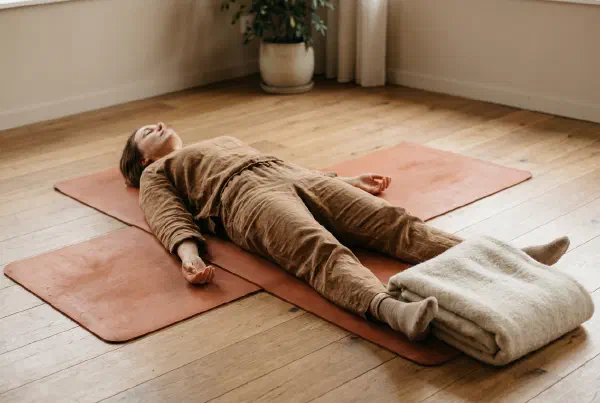
For a session you need a comfortable posture. Three variants have proven their worth: lying on your back with your arms loosely placed, sitting in an armchair with supported arms, or the so-called cab driver’s posture – sitting upright on a chair, the upper body sunk slightly forward, the forearms resting on the thighs. Close your eyes and find a quiet place where you can be undisturbed for a few minutes.
Here is how a short session runs:
- Tune in with the calm phrase: “I am very calm.”
- Go through the exercises, repeating each phrase calmly.
- Take back at the end – and this is important: end the session actively by bending and stretching your arms firmly, breathing in deeply and opening your eyes. A typical phrase for this: “Arms firm – breathe deeply – eyes open.”
Taking back brings you out of the relaxed state and back into an awake, everyday mode. Never skip it – unless you are practising right before falling asleep and want to stay in the calm.
Tips for practising as a beginner
- Start small: Two to three minutes per session is enough to begin with. Better short and regular than rare and long.
- Find fixed times: First thing in the morning or in the evening before sleep makes the training easy to turn into a habit.
- Bring patience: For many people the feeling of heaviness only sets in after a few days. That is normal and not a sign you are doing anything wrong.
- Don’t force it: If a phrase doesn’t “take”, move on calmly. The pressure to do it right is the biggest brake on relaxation.
- Add calm: A quiet environment makes getting started easier. If you like, combine the training with other relaxation techniques against stress.
Who it is suitable for and a note on guidance
Autogenic training is suitable for anyone who wants to find calm consciously in everyday life and meet stress more serenely. It needs no aids and, after a little practice, can be done almost anywhere. If you want to learn the method properly from the ground up, a guided course is a good place to do so – many adult education centres and wellness providers offer introductory courses in which an instructor teaches the phrases and the sequence.
Understand autogenic training as a method for relaxation and stress reduction in the sense of wellness and lifestyle. It does not replace medical or therapeutic treatment. If tension, restlessness or other complaints weigh heavily on you or persist, talk to a doctor when in doubt. If you enjoy the quiet pause, learning to meditate is a related path that complements it well.
Frequently asked questions (FAQ)
How long does it take for autogenic training to work?
That is very individual. Many beginners feel the first sense of heaviness after a few days of regular practice; for others it takes a few weeks until a session feels natural. Regularity is what matters: short daily sessions get you further than rare long ones.
How often a day should I practise?
For the start, two to three short sessions a day are ideal, each only a few minutes. That way the sequence becomes anchored without feeling like a chore. Find fixed times when you can be undisturbed.
Do I have to do the exercises lying down?
No. You can lie down, sit in an armchair or take the cab driver’s posture on a chair. What matters is that the posture is comfortable and lets you release your muscles. Try out what feels easiest for you.
What is taking back and why is it important?
Taking back ends the session actively: you bend and stretch your arms firmly, breathe in deeply and open your eyes. This brings you out of the relaxed state and back into an awake mode. Only if you practise right before falling asleep can you leave it out.
Can I learn autogenic training on my own?
Yes, the standard level can be learned well on your own. If you want to build it up cleanly from the start, however, you benefit from a guided introductory course, for example at an adult education centre or with a wellness provider. There an instructor teaches the phrases and sequence and answers questions directly.