DIY hair mask: simple recipes that actually work
In this article
Note: This article contains affiliate/advertising links. As an Amazon Associate we earn from qualifying purchases. If you click such a link and buy something, we may receive a small commission – at no extra cost to you.
Straw-like lengths, brittle ends, greasy roots – and a bathroom shelf full of half-empty tubes that fix none of it. Making a DIY hair mask is the obvious alternative: the ingredients are usually already in your kitchen, you know exactly what is in the mix, and you can tailor it to your hair type. Here you will find five proven recipes with clear quantities, the right way to apply them, and the mistakes that most often ruin a homemade treatment.
Why make your own hair mask?
The most obvious reason is cost: an avocado, a spoonful of honey and a little oil cost a fraction of a salon treatment. Then there is control – you know what ends up on your head and can simply leave out fragrance, silicones or alcohol. And you can adapt: fine hair needs a light mix, thick and porous hair tolerates far more oil.
The crucial catch: homemade masks are not preserved. Foods like egg, quark or avocado spoil quickly. So only mix the amount you need right now. Leftovers keep in a closed jar in the fridge for two to three days at most – if the mixture smells sour or changes colour, throw it out.
And: do a patch test. Apply a little of the finished mix to the crook of your elbow and wait 24 hours. Natural ingredients are not automatically well tolerated – honey, nuts and essential oils in particular are common triggers.
Conditioner, mask or treatment – the difference
The terms get used interchangeably. In practice: a conditioner stays on for one or two minutes, coats the outside and makes hair easy to comb. A mask or deep treatment works for 20 to 30 minutes and carries moisture and oil deeper into the hair structure. Between mask and treatment there is no real difference, only marketing names. All the recipes here are treatments in the sense of: leave them on longer.
Five recipes by hair type
1. Oil treatment for dry, damaged hair
Warm 2 tbsp olive oil (3–4 tbsp for long hair) to hand temperature and work it into the lengths and ends. Leave on for 30 minutes, then wash out twice with a mild shampoo.
Coconut oil works instead of olive oil – with one caveat: it penetrates deep into the fibre and over time makes some hair (especially fine or protein-rich hair) stiff rather than soft. If your hair feels firmer afterwards than before, it is simply not your oil; almond, argan or jojoba oil are gentler alternatives.
2. Avocado and honey mask for shine
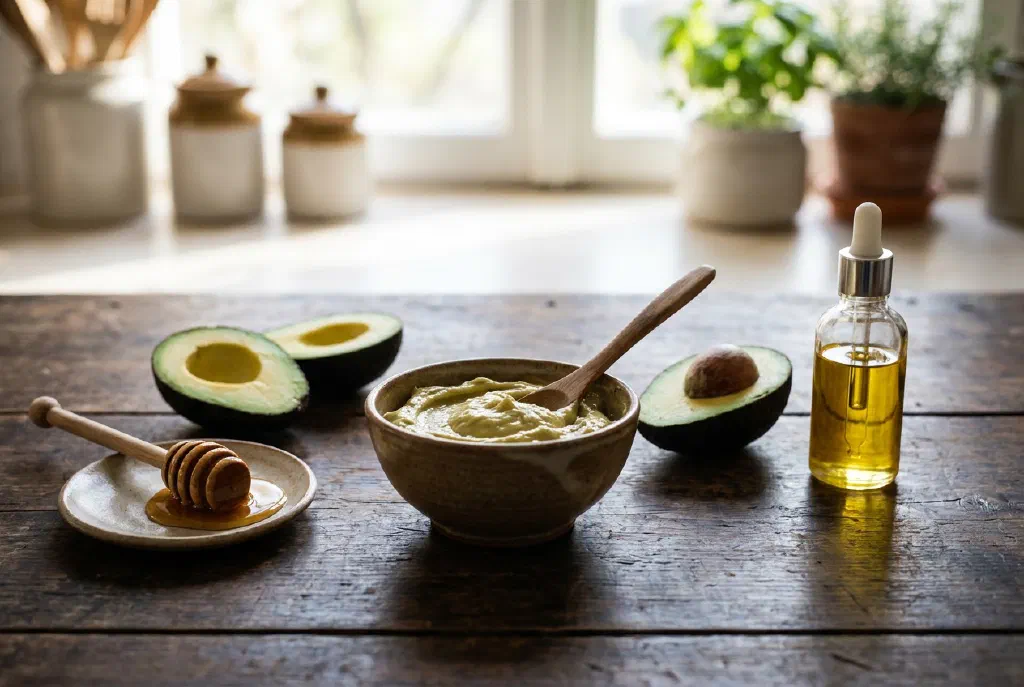
Mash 1 ripe avocado (completely smooth – otherwise you will be combing out lumps for hours), stir in 1 tbsp honey and 1 tbsp olive oil. Apply to the lengths, leave on for 20–30 minutes under a towel, rinse thoroughly. The fats in the avocado make hair supple, the honey binds moisture.
3. Quark or yoghurt treatment for greasy hair
Mix 3 tbsp plain yoghurt or low-fat quark with 1 tsp lemon juice. Apply to the lengths only, not the roots. Leave on for 15–20 minutes, rinse with lukewarm water. This one cares without weighing hair down – ideal if oils make your hair fall flat instantly.
4. Egg treatment for body and strength
Whisk 1 whole egg (yolk only for fine hair) with 1 tbsp olive oil and apply to towel-dried hair. Leave on for 20 minutes – and then rinse with cold water. Warm water makes the egg white coagulate, and scrambled egg is almost impossible to get back out of your lengths.
5. Aloe vera treatment for the scalp
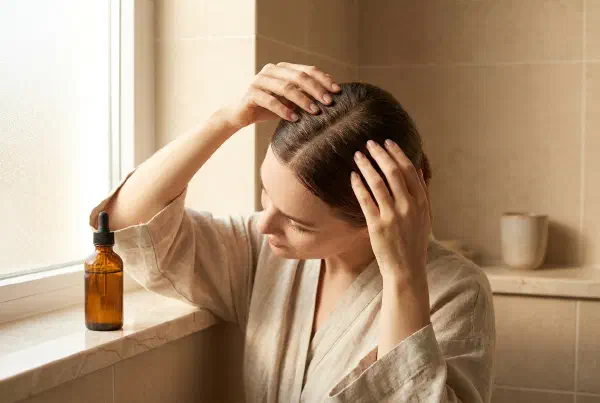
Apply 2 tbsp pure aloe vera gel directly to the parted scalp and massage in gently. Leave on for 20 minutes, then wash out. Pleasantly cooling and light, without greasing. With a dry scalp this is the best-tolerated option; if you also want to lift deposits, combine it with a scalp scrub beforehand.
How to apply the mask correctly
- Apply to towel-dried hair: Soaking wet hair dilutes the mix, dry hair absorbs it unevenly.
- Distribute properly: For dry hair work from ear level down; with greasy roots stick strictly to the lengths and ends. Only scalp treatments belong at the roots.
- Warmth helps: Pin the hair up and put a towel or shower cap over it – that opens the cuticle.
- Wait 20–30 minutes. Longer achieves nothing.
- Rinse thoroughly: Put shampoo into the oily hair, work up a lather, only then add water. The other way round, water simply beads off the oil.
How often? Once a week is enough. For very damaged hair two applications are fine; more is over-conditioning.
Common mistakes
- Too much oil. The classic: tip four tablespoons into your hair and you will wash it five times and still have a greasy film. Start sparingly.
- Lemon and baking soda as a treatment. Both are too harsh: baking soda is strongly alkaline and makes the cuticle stand up, neat lemon juice irritates the scalp. The teaspoon in the yoghurt is harmless – a lemon-and-baking-soda “detox” is not.
- Lumpy mixtures. Purée anything that is not completely smooth.
- Wrong expectations with hair loss. A DIY mask cares for the hair surface and the scalp – it does not stop hair loss. If your hair is visibly thinning, have the cause checked medically; the guide on hair loss in women gives an overview. Stubborn dandruff is not a DIY case either.
Frequently Asked Questions (FAQ)
How long does a homemade hair mask keep? Without preservatives, not long: two to three days in a closed jar in the fridge is the maximum, and with egg-based mixes you should keep nothing at all. The safest approach is to mix only the amount you will use straight away.
Can I leave the hair mask on overnight? There is no need – after 20 to 30 minutes the mask has done what it can do. With oil, a whole night makes rinsing unnecessarily hard, and egg or quark do not belong in your hair for hours anyway.
Is coconut oil suitable for every hair type? No. Coconut oil penetrates deep into the fibre, which many hair types like – but fine or protein-rich hair can turn stiff and straw-like from it. If your hair feels harder after the treatment than before, switch to almond, jojoba or argan oil.
Does a homemade hair mask help against hair loss? No. A mask cares for the hair surface and the scalp; it does not influence hair growth. If your hair is thinning noticeably, bald patches appear or your scalp itches persistently, have the cause checked medically.