Head Spa: Procedure, Benefits and What Makes the Trend
In this article
Note: This article contains affiliate/advertising links. As an Amazon Associate we earn from qualifying purchases. If you click such a link and buy something, we may receive a small commission – at no extra cost to you.
A head spa is a feel-good treatment that focuses entirely on your scalp, your hair and your relaxation. Originally from Japan, the concept combines thorough scalp care with an extensive massage and a calm, almost meditative atmosphere. Instead of just washing the hair, the scalp here is treated like the skin on your face: cleansed, cared for and massaged to boost circulation. In this guide you will learn how a head spa works, what it can achieve and what to look out for when booking.
What exactly is a head spa?
In a head spa, the scalp takes center stage – the area that often gets neglected in regular hair care. The idea behind it: a healthy, well-circulated and clean scalp is the foundation for a pleasant skin feeling and hair that looks strong. At the same time, the scalp is rich in nerve endings, which is why a gentle massage there is experienced as especially soothing.
A head spa is therefore less a medical treatment and more a wellness application. The focus is on relaxation, self-care and an all-round well-groomed feeling. Many studios combine the treatment with dimmed lighting, calm music and warm towels to create a noticeable break from everyday life.
The typical course of a treatment
Even though every studio adds its own touches, a head spa usually follows a similar sequence:
- Consultation and analysis: At the start, your scalp is often examined – sometimes with a small magnifying camera. This makes it possible to assess the skin’s condition and care needs.
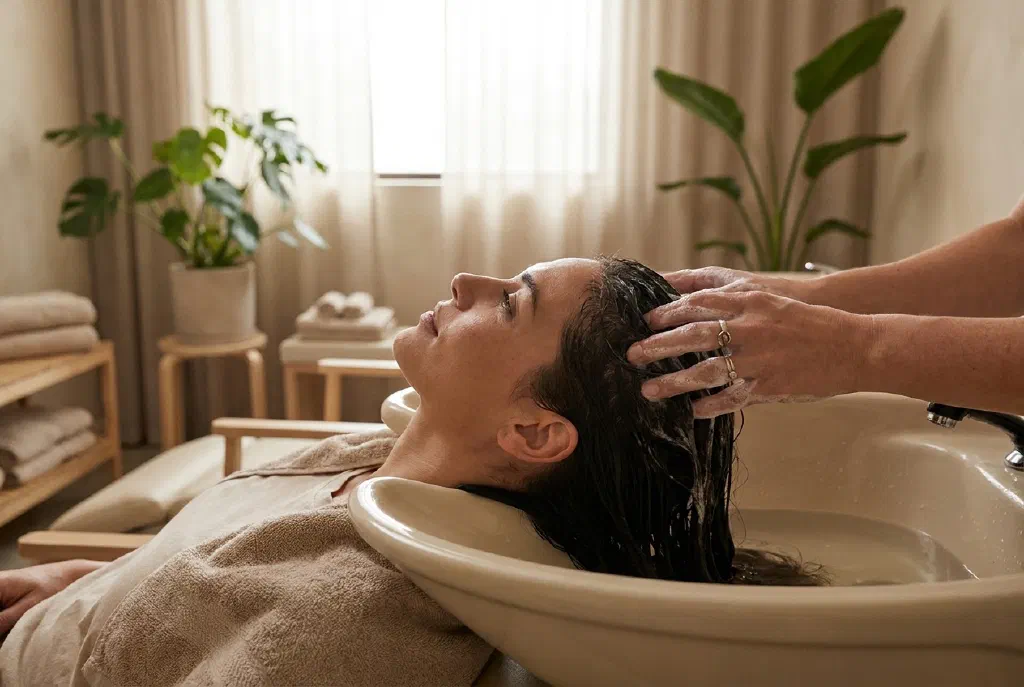
- Cleansing: A thorough wash removes excess oil, styling residue and buildup. A gentle exfoliation for the scalp is frequently used.
- Massage: The centerpiece is the extensive scalp massage, often extended to the neck, shoulders and temples. It is meant to stimulate circulation and release tension.
- Care and mask: A nourishing hair mask or scalp serum is left to work, sometimes supported by heat or steam.
- Finish: To wrap up, the hair is rinsed out, lightly dried and styled. Many treatments end with a quiet moment to let it all sink in.
A complete session lasts between 30 and 90 minutes, depending on its scope. Shorter express versions focus mainly on the massage, while more comprehensive packages combine analysis, exfoliation and a mask.
Dry or wet head spa
Some providers distinguish between a dry head spa, which consists almost entirely of massage, and a wet head spa with washing, exfoliation and a mask. The dry format works well if you want to head to an appointment freshly styled, while the wet version offers the more intensive care.
What effect can you expect?
The most noticeable effect of a head spa is probably relaxation. The slow, even massage on the head is experienced by many people as calming and can help to relieve tension in the short term. In this sense, the head spa joins the ranks of classic relaxation rituals – much like a sauna session. If such breaks interest you, you’ll find more inspiration in our guide to sauna bathing the right way.
Beyond that, many report a well-groomed, light scalp feeling after the treatment, because buildup has been removed and the hair has been thoroughly cleansed. The massage also stimulates local circulation, which is perceived in the short term as a pleasant warming sensation. If you’re generally concerned about thinning hair, it’s worth reading our guide to causes of hair loss in women.
It’s important to have realistic expectations: a head spa is a feel-good treatment, not a medical procedure. It can support general well-being and hair care, but it does not replace medical or dermatological treatment. If you suffer from persistent itching, flaking, hair loss or skin changes, you should have it checked by a doctor when in doubt before booking a purely wellness-focused application.
Who is a head spa suitable for?
In principle, a head spa is suitable for most people looking for a break or wanting to do something good for their scalp. It is often experienced as especially pleasant by:
- People with a lot of stress or tension in the neck and shoulder area
- anyone who wants their scalp thoroughly cleansed, for instance with frequent styling
- people who generally enjoy massages and calm wellness rituals
Caution is advised with acute skin problems, fresh injuries or inflammation of the scalp. In such cases, an intensive massage or exfoliation is not ideal – clarify it in advance with your studio and, if necessary, with a doctor. If you react sensitively to fragrances, it’s also worth asking about the products used beforehand.
Head spa at home: is that possible?
A full studio treatment can’t be replicated one-to-one at home, but you can treat yourself to a simplified ritual. A mild scalp exfoliation, a nourishing hair mask and, above all, a calm, undisturbed atmosphere are helpful. A gentle massage with your fingertips over a few minutes can already have a relaxing effect. If you’d like to expand on the wellness idea, combine it with a sauna session or steam bath – we explain the differences between the two options in our article sauna or steam bath.
Either way, the rule is: a head spa is first and foremost a moment of indulgence. The greatest benefit lies in consciously taking time to relax.
Frequently asked questions (FAQ)
How often should you have a head spa? That depends on your goal. As a pure relaxation ritual, you can enjoy it as often as it does you good – many choose a monthly rhythm. For scalp care, an occasional application is often enough; a fixed schedule isn’t necessary.
Is a head spa also suitable for a sensitive scalp? Often yes, as long as there are no acute skin problems. Let your studio know in advance so that mild products and a gentle technique can be chosen. In the case of inflammation, severe itching or skin changes, you should have it checked by a doctor beforehand.
Does a head spa help against hair loss? A head spa is a feel-good and care treatment, not a medical procedure against hair loss. The massage can stimulate circulation and be pleasant, but there is no promise of a cure. With persistent hair loss, a medical evaluation makes sense.
How long does a treatment take? Depending on its scope, a head spa usually lasts between 30 and 90 minutes. Express versions focus on the massage, while more comprehensive packages additionally include analysis, exfoliation and a mask.