Learning to meditate: a guide for beginners
In this article
Note: This article contains affiliate/advertising links. As an Amazon Associate we earn from qualifying purchases. If you click such a link and buy something, we may receive a small commission – at no extra cost to you.
You want to learn to meditate but aren’t quite sure how or where to begin? Then you’re in the right place. To many people, meditation sounds like an esoteric effort, yet at its core it’s surprisingly simple: you keep gently bringing your attention back to an anchor, such as the breath. In this guide you’ll get everything you need to get started – the right preparation, a step-by-step guide for your first meditation and simple forms of practice you can try right away.
What meditation actually is
Meditation is an exercise in attention. You choose a focus – usually the breath – and keep returning to it the moment you notice your thoughts have wandered. At its core, nothing more happens. It isn’t about thinking of “nothing” or forcing an empty head. That’s the most common misconception and the reason many people give up in frustration.
What you’re training is a form of mindfulness: the ability to stay in the moment instead of being swept away by worries, to-do lists and loops of rumination. Over time, many people find it easier to keep their focus and to find a sense of inner calm in everyday life. Meditation is a wellness practice for relaxation and self-awareness – not a remedy and not a substitute for therapeutic or medical help if you’re feeling persistently unwell.
If you’d like to dive deeper into the topic of presence of mind, our mindfulness exercises offer many more approaches that pair well with meditating.
Preparation: place, posture and duration
Before you start, set up good conditions for yourself. You don’t need any equipment for this – just a few minutes without interruption.
- Place: find a quiet spot where you’ll be undisturbed for the duration. Phone on silent, door closed. A fixed place helps, because your mind quickly links it with “now it’s time to meditate”.
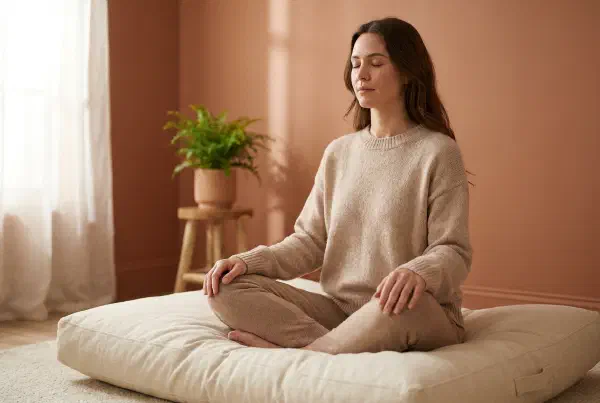
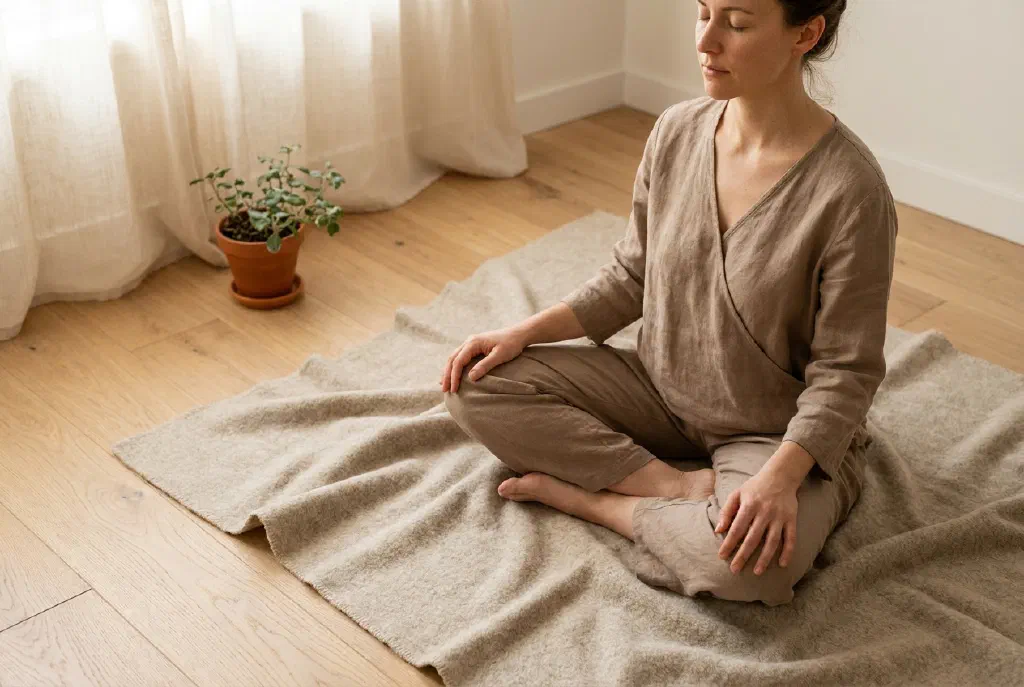
- Posture: sit upright but relaxed – on a chair, a cushion or the floor. Your back is straight, your shoulders drop down loosely, your hands rest on your thighs. What matters is a posture that keeps you alert without being a strain. Lying down, beginners often fall asleep.
- Eyes: close your eyes, or let your gaze sink softly onto a point in front of you with half-closed lids.
- Duration: start small. Five minutes is plenty to begin with. Set yourself a gentle timer so you’re not constantly checking the clock. Only increase after a few weeks, once it feels comfortable.
The best time of day is the one you’ll actually stick to. Many people meditate in the morning after getting up or in the evening before sleep, because these moments are easy to tie into a habit.
Step by step: your first meditation
The following breath meditation is the classic way in. It requires no prior knowledge. Read the steps through once and then simply begin.
- Get ready to sit. Upright, relaxed posture, hands on your thighs, eyes closed.
- Arrive. Take two or three calm breaths and feel the contact with your seat, your feet on the floor, the weight of your body.
- Find the breath. Bring your attention to wherever you feel the breath most clearly – at the nostrils or at the belly. Don’t change it, just observe.
- Watch in and out. Follow every inhale and every exhale with your attention. You can silently say “in” and “out” along with it, if that helps.
- Notice the wandering. At some point you’ll realise your mind is somewhere else. This very moment of noticing is the heart of the practice.
- Return kindly. Without getting annoyed with yourself, gently bring your attention back to the breath. As often as it takes – even twenty times in five minutes is completely fine.
- End deliberately. When the timer sounds, slowly open your eyes and take a moment before you stand up.
That’s it. These seven steps are basically the whole meditation – everything else is a variation on the same principle.
Simple forms of meditation at a glance
Once breath meditation feels familiar, you can try different forms. Pick the one that feels right for you.
- Breath meditation: the classic described above. The breath as an anchor is always with you, which makes this form ideal for starting out.
- Body scan: you slowly travel with your attention through the body – from your feet to your head – noticing each region without judging anything. Great for finding physical relaxation after a stressful day.
- Guided meditation: a voice leads you through the exercise. For many beginners the easiest option, because you only have to follow along and the thread doesn’t snap so easily.
- Walking meditation: you walk very slowly and direct your attention to each step – the rolling of the foot, the shift of weight. Ideal if sitting still is hard for you. If you prefer to practise mindfulness in motion, Pilates for beginners combines conscious breathing with calm exercises for the core.
A lovely addition is some conscious breathing exercises, which you can use before the actual meditation to settle down more quickly. If mindful rituals appeal to you, it’s also worth seeing how a Reiki session works as a relaxation ritual. If you like to lean on sound while letting go, the effects and procedure of a singing bowl massage offer a sensory complement to silent seated meditation.
Common hurdles – and how to handle them
Almost everyone trips over the same things at the start. Good to know: these aren’t signs that you “can’t do it”, but completely normal companions.
- “I have too many thoughts.” That’s not a disruption of meditation, it is the meditation. Your job isn’t to prevent thoughts but to notice them and return kindly to the breath.
- “I’m totally restless.” Inner restlessness is common, especially in the evening. It helps to start with a few deep, long exhales, or to begin with a walking meditation before you sit.
- “I keep falling asleep.” Then you’re probably sitting too comfortably. Sit more upright, open your eyes slightly, or meditate at a more alert time of day.
- “I don’t have time.” Almost everyone has five minutes. Attach the exercise to an existing habit – for example right after brushing your teeth.
It also helps to create a kind inner stance with a few positive affirmations: you practise patience with yourself, and that is worth more in meditation than any perfect session. The most important factor remains regularity – don’t set yourself a perfectionist goal but a low bar you almost never miss. If a day falls through, you simply carry on the next one without self-criticism.
Frequently asked questions (FAQ)
How long does it take until I can meditate?
You master the basic technique after your first session – there’s nothing more to learn than “bring your attention back to the breath”. The fact that it feels easier and more natural comes with practice over a few weeks. What matters is regularity, not perfection.
How many minutes should I meditate as a beginner?
Start with five minutes a day. That’s short enough to really stick with and long enough for a noticeable effect. Only once that length feels self-evident should you increase to ten or fifteen minutes.
Do I have to think of nothing while meditating?
No, and that’s the most important reassurance of all. Thoughts always come – even for experienced meditators. The practice consists of noticing them and bringing your attention back kindly, not in forcing an empty head.
Do I need an app or special equipment?
No. For breath meditation you only need yourself, a few quiet minutes and a timer. A guided meditation can make the start easier, but it isn’t a must. A comfortable cushion is nice, but a chair does the job too.
What do I do if I simply can’t settle down?
Start with a few long exhales to wind the body down, or choose a walking meditation instead of sitting still. On some days there’s more restlessness than on others – notice it without judging it, and just keep the session shorter if you need to.