Pilates for beginners: the basics and your first exercises
In this article
Note: This article contains affiliate/advertising links. As an Amazon Associate we earn from qualifying purchases. If you click such a link and buy something, we may receive a small commission – at no extra cost to you.
From the outside, Pilates looks unassuming – calm, controlled movements with no rush – yet it is surprisingly demanding. That is exactly what makes Pilates for beginners so appealing: you need no prior experience, no equipment and no brute force. Instead, you learn to control your movements deliberately from the centre of your body. In this guide you will find the basics explained clearly – the famous “Powerhouse”, correct breathing and the principle of control – plus seven starter exercises you can try on the mat today.
What exactly is Pilates?
Pilates is a full-body practice built on conscious, controlled movement. At its heart sits what Pilates calls the “Powerhouse”: the deep muscles of the abdomen, lower back, pelvic floor and glutes. Every movement is driven from this stable centre. The goal is a strengthened core, better mobility and a balanced sense of your body – not bulky muscles or being worked to exhaustion.
A few core principles carry the whole practice:
- Centring: Every movement starts from your core. Imagine gently drawing your navel towards your spine.
- Control: You lead each movement deliberately, with no momentum and no jerking. Slow and clean beats fast and sloppy.
- Breathing: The breath flows along with the movement; you usually exhale during the effort. It should support the movement, not stall it.
- Precision and focus: Your attention stays on what your body is doing right now.
Once you internalise these principles, you get far more out of every single repetition – and that is what Pilates is all about.
Breathing the right way
In Pilates, breathing is not an afterthought; it is part of the exercise. The typical pattern is lateral chest breathing: as you inhale, the ribs widen sideways while the belly stays fairly firm, because the core is engaged. As you exhale, you gently draw the abdominal wall inwards. As a rule of thumb, you exhale during the demanding phase of a movement and inhale on the return.
Let the breath flow calmly and never hold it. If the coordination feels tricky at first, that is completely normal – focus on the movement first and let the breathing fall into place gradually. If you also want to practise winding down, our relaxation techniques against stress offer breathing exercises that pair nicely with this.
What you need to get started
The big advantage of Pilates is its low barrier to entry. At the start, very little is needed.
- A non-slip mat as a cushioned base – the most important purchase.
- Comfortable, stretchy clothing that lets you move freely.
- A little space to stretch out fully and rest your arms to the sides.
- Optionally a small cushion under your head if your neck otherwise over-extends.
Equipment like the “Reformer” belongs in a studio and is not needed for beginners. Mat work at home covers all the basics.
Seven exercises for beginners
Perform each exercise slowly and with control, breathe consciously and listen to your body. Keep your lower back stable and gently engage your core.
- The Hundred: Lie on your back, lift the bent legs and raise your head and shoulders slightly off the floor. Pump your straight arms firmly up and down beside the body – inhale for five pumps, exhale for five. Build towards 100 pumps. Beginners keep their feet on the floor.
- Roll-up: Lie flat on your back, arms overhead. Roll up vertebra by vertebra until you reach upright towards your toes, then roll back down with the same control. 5 to 8 repetitions.
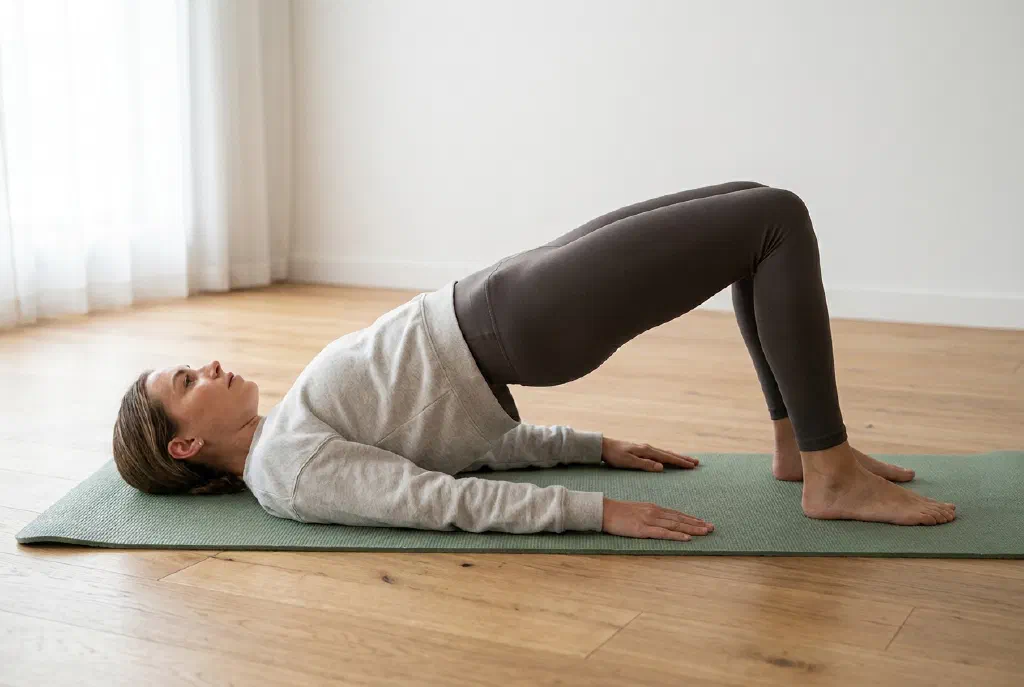
- Bridge (shoulder bridge): On your back, feet hip-width apart. Lift the pelvis vertebra by vertebra until thighs and torso form a line, hold briefly, then lower slowly. 8 to 10 repetitions.
- Single Leg Stretch: On your back, head and shoulders slightly raised. Draw one leg to the chest while the other stretches long forwards, then alternate. The core stays firm. 8 to 10 changes per side.
- Roll like a Ball: Sit upright, hug your knees, round your back and roll gently back and up again without swinging. It trains balance. 6 to 8 repetitions.
- Swan (gentle back extension): Lie on your front, hands under your shoulders. Lift the upper body gently while keeping the neck long. Only as far as stays comfortable. 5 to 6 repetitions.
- Plank (forearm support): On forearms and toes, hold the body as a straight line, core firm, pelvis neither sagging nor hiking up. Start with 15 to 20 seconds and build slowly.
At the beginning, do a clean selection rather than ticking off all seven exercises. Three or four exercises, well executed, are a full starter session. If you prefer something even gentler on the joints, our gentle water aerobics exercises for the joints make a good complement.
Tips and common mistakes
A few points keep your training effective and pleasant:
- Going too fast: The most common mistake. Pilates thrives on slow control, not many quick repetitions.
- Forgetting to breathe: Holding your breath creates tension. Let the breath flow along calmly.
- Hollow back: If the lower back sags, the core is not engaged. Gently draw the belly in.
- Tense neck: In exercises with the head raised, look diagonally towards your knees and do not pull the chin to the chest.
- Too much at once: Two or three times a week for 20 to 30 minutes is a realistic and effective start.
If you also want to release the fascia, our guide to foam roller exercises offers suitable movements for after your session.
Pilates or yoga?
Both are calm, controlled forms of training – but the emphasis differs. Pilates clearly focuses on strengthening the core and on controlled, often repeated movement sequences. Yoga combines postures with breathing, mobility and a stronger meditative element. If you specifically want to build the Powerhouse, Pilates is the right choice; if you are after mobility and inner calm, yoga for beginners often fits better. Much of it combines well – similar to the flowing sequence of the Five Tibetans, which is also built on conscious movement.
Frequently asked questions (FAQ)
How often should I do Pilates as a beginner?
Two or three times a week for 20 to 30 minutes is a good start. Consistency does more than rare, long sessions. Allow enough rest so the muscles can recover.
Do I need a class or studio to begin?
No. The mat exercises can be learned well at home. That said, a class or experienced guidance helps you learn the technique cleanly from the start and correct mistakes like the hollow back early on.
Is Pilates suitable for completely unfit people?
Yes, Pilates is easy to scale and you set your own pace and volume. Begin with the simple variations and progress slowly. If you have existing complaints, for example in your back, or are pregnant, clarify suitability with a doctor first – Pilates is no substitute for physiotherapy or medical treatment.
When will I notice the first progress?
A better sense of your body and more core stability often appear after just a few weeks of regular practice. Mobility and strength develop gradually – patience and clean execution pay off here more than ambition.