Progressive muscle relaxation: a Jacobson step-by-step guide
In this article
Note: This article contains affiliate/advertising links. As an Amazon Associate we earn from qualifying purchases. If you click such a link and buy something, we may receive a small commission – at no extra cost to you.
When the day has been packed with appointments and your shoulders feel as if they have grown to your ears, you do not want to spend ages listening inward – you want to feel the tension ease. This is exactly where progressive muscle relaxation comes in, often shortened to PMR. The method works with a simple, almost playful alternation between deliberately tensing and releasing individual muscle groups. In this guide you get the complete Jacobson instructions: the basic principle, the sequence through every region of the body, a short version for when you are on the go, and tips that make it feel pleasant from your very first attempt.
What progressive muscle relaxation is
Progressive muscle relaxation goes back to the American physician and physiologist Edmund Jacobson, who developed the method in the 1920s and 1930s. His observation was as simple as it was clever: inner restlessness and physical muscle tension are closely linked. Anyone who learns to deliberately loosen the muscles will also find it easier to settle down overall.
The word “progressive” here does not mean “fast” but “step by step” – you work your way through the entire body piece by piece. Today PMR ranks among the best-known and easiest-to-learn relaxation methods of all, because it requires no particular belief and no prior experience. You need nothing but a few quiet minutes and your own body. If you want to compare different approaches, it is worth a look at the overview of relaxation techniques.
The basic principle: the contrast does the work
The core of the method is the deliberate switch between tension and release. You tense a single muscle group clearly, but without cramping, for a few seconds. Then you let the tension go all at once and direct your attention to how the muscle feels now – heavy, warm, loosened.
This contrast is the real trick. In everyday life many people no longer notice how tense they actually are, because the state has become a habit. By actively tensing first, you make the difference to the released state tangible. With a little practice this trains your body awareness to the point where you notice the beginnings of tension sooner. As with autogenic training, the rule is: the more often you practise, the faster the loosened feeling sets in.
The sequence step by step
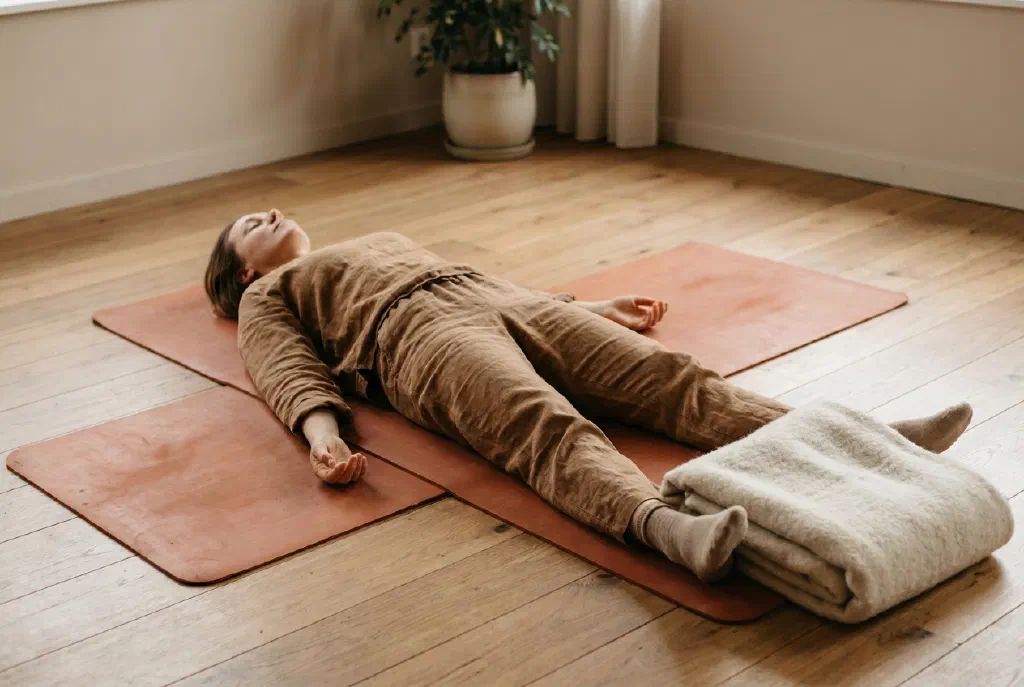
Find a quiet place where you will be undisturbed for fifteen to twenty minutes. Sit comfortably or lie on your back, close your eyes and take a few calm breaths. The basic rule for every muscle group: tense for about five to seven seconds, then release and stay with the sensation for about twenty to thirty seconds. Breathe in while tensing and out while releasing.
- Hands and arms: Clench your right hand into a fist and tense the forearm. Release, feel it. Do the same on the left side. Then both upper arms: bend the arms and tense the biceps, then release.
- Face: Wrinkle your forehead or raise your eyebrows, hold briefly, then release. Squeeze your eyes shut, release. Press your lips together and push your tongue gently against the roof of your mouth, then release. The face carries more tension than people often think.
- Neck and shoulders: Pull your shoulders up towards your ears, hold the pull, then let them sink down heavily. Feel how the neck becomes longer and softer.
- Back: Gently draw your shoulder blades back together, as if you wanted to bring them to touch. Hold, then release and let the back grow broad. Avoid arching into a hollow back.
- Belly: Tense your abdominal wall as if you were bracing for a light nudge. Hold, then release and let your breathing flow freely again.
- Legs and feet: Tense your thighs, release. Pull your toes up towards your shins, release. To finish, gently curl your toes, hold briefly and then let everything go.
At the end of the round, stay lying or sitting for a moment and sense your whole body as one. Then stretch, take a deep breath and slowly come back into the room.
The short version for everyday life
You will not always have twenty minutes. For those moments there is a short version in which you combine several regions into larger groups: both arms and hands together once, the whole face with neck and shoulders once, belly and back once, both legs and feet once. Four rounds instead of many separate ones – that fits into five minutes and can even be done discreetly at your desk.
Once you have practised the long version for a few weeks, you can often call up the relaxation later with just one or two deep breaths and a deliberate release of the shoulders. This link between breath and release is well deepened with targeted breathing exercises for relaxation.
Tips and the right posture
- Do not strain: Tense firmly, but never to the point of cramp. A moderate, clear pull is entirely enough.
- Skip sore spots: If you have an acute ache or an injury somewhere, simply leave that region out instead of tensing it.
- Stay calm: If your thoughts wander, that is normal. Gently bring your attention back to the current muscle group.
- Regularity beats duration: Five minutes daily is better than one long session per week.
If you like to combine PMR with a physical counterbalance, the method and gentle foam roller exercises go well together – both train your sense of tension and release in the body.
Who the method suits
Progressive muscle relaxation is easy to access for most people because it is active: you do not have to “do nothing” and keep still, but get to take something on. That makes it especially appealing for everyone who struggles to settle down with pure silence. And if your inner restlessness shows up mainly as physical tension, the route through the muscles is an obvious choice.
Understand PMR as what it is: a relaxation method for more composure and body awareness in everyday life – not a substitute for medical or therapeutic treatment. If persistent tension, restlessness or other complaints are weighing on you, talk it over with a doctor when in doubt.
Frequently Asked Questions (FAQ)
How long does a session of progressive muscle relaxation take?
The detailed form through all muscle groups takes about fifteen to twenty minutes. You can manage the short version with combined regions in around five minutes. For getting started, the long version makes sense because it lets you get to know the individual groups better.
How often should I practise?
Regularity matters more than length. Even a short daily session does more than one long one per week, because over time your body calls up the link between tension and release ever faster. It is best to find a fixed time, for example in the evening before going to sleep.
Should I practise sitting or lying down?
Both are possible. Many find letting go easier when lying down, while sitting lets you slip the exercise discreetly into daily life, for instance at your desk. Try both and decide by feel.
Can I do something wrong while practising?
There is little you can seriously get wrong. Just make sure not to cramp up or hold your breath – relaxation should never feel like effort. If you accidentally tense a region too hard, simply release and calmly carry on.
What is the difference from autogenic training?
With progressive muscle relaxation you proceed physically, through active tensing and releasing. Autogenic training, on the other hand, works with imagination and formulas such as “my arm is heavy”. Many find the active approach of PMR an easier way in.