Qigong: origin, principle and exercises for beginners
In this article
Note: This article contains affiliate/advertising links. As an Amazon Associate we earn from qualifying purchases. If you click such a link and buy something, we may receive a small commission – at no extra cost to you.
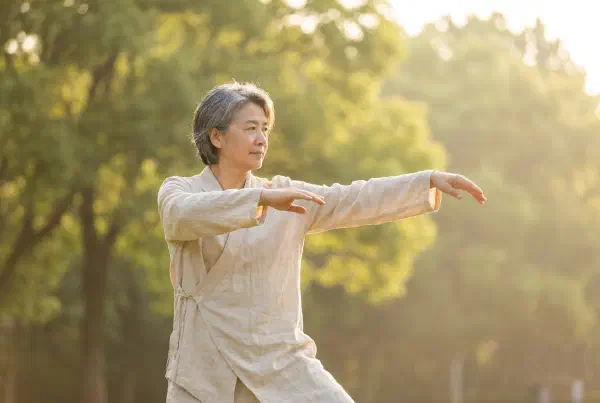
Slow, flowing movements, calm breathing and a moment of focus in the middle of everyday life – that is qigong. This East Asian movement and relaxation practice has its roots in China and can be done almost anywhere, without equipment and at any pace. This guide shows you where qigong comes from, what principle lies behind it and what a few simple beginner exercises look like – so you can try for yourself whether this calm form of movement does you good.
What qigong is and where it comes from
Qigong (pronounced roughly “chee-gung”) is an exercise practice cultivated in China for centuries. The term is made up of “qi” and “gong”, where “gong” means steady practice or hard-earned skill. Qigong covers a large family of exercise systems – from calm, almost meditative forms to more active sequences.
By tradition, qigong is considered part of Traditional Chinese Medicine (TCM), alongside elements such as herbal lore and manual techniques. “Qi” is understood as a kind of life energy that, according to this idea, flows through the body. An important note for context: the qi concept is a traditional model from the Chinese cultural sphere, not a scientifically measurable term. From a Western point of view, qigong can soberly be described as a mindful movement and breathing practice. You will find related ideas in acupressure and its pressure points or in manual Chinese tuina massage. The same energy model also underlies acupuncture and what the needles do.
The principle: movement, breath and focus
Unlike a workout, qigong is not about performance, speed or maximum strength. What matters is the conscious interplay of three elements:
- Slow movement: The sequences are soft, flowing and even – controlled and without jerking, often in repetitions that blend into one another.
- Calm breathing: The breath flows deep and relaxed, usually through the nose and down into the belly. Movement and breathing gradually come into sync.
- Focus and mindfulness: Your attention rests on the movement and on how your body feels. Thoughts may come and go without you following them.
This creates the calm, gathered feeling that many value in qigong. It is less about performing a form perfectly than about being present. You will find a similar idea in targeted breathing exercises for relaxation.
Simple beginner exercises step by step
The following exercises are gentle and need no prior experience. Stand loosely, feet about hip-width apart, knees slightly bent, shoulders relaxed. Breathe calmly and listen to your body.
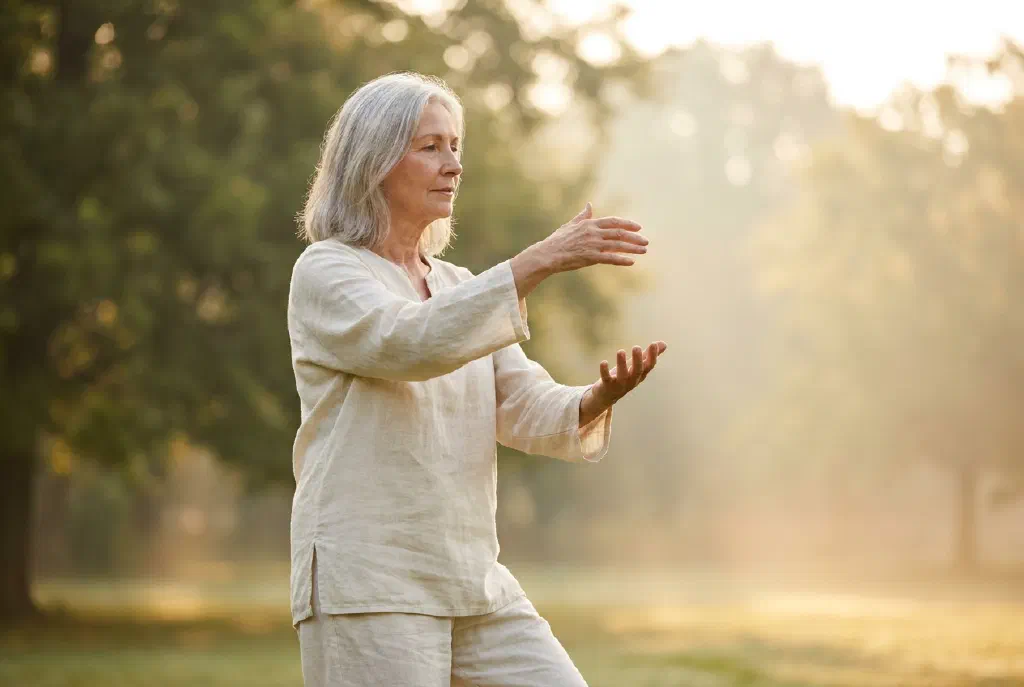
- Standing like a tree (resting posture): Stand upright and let your arms hang slightly rounded in front of your belly, as if holding a large ball. Breathe calmly, feel the floor under your feet and hold the posture for 1–2 minutes.
- Raising and lowering the arms: As you breathe in, slowly raise your arms in front of your body up to about shoulder height; as you breathe out, lower them just as slowly. 8–10 times, with breath and movement flowing together.
- Pushing clouds: Gently shift your weight from one leg to the other while moving your hands loosely back and forth in front of your upper body, as if pushing light clouds aside. The movement comes from your centre.
- Supporting the sky: As you breathe in, raise both hands above your head, palms facing up, as if supporting the sky. As you breathe out, lower the arms out to the sides. 6–8 repetitions.
- Gentle shake-out: To finish, bounce lightly on the balls of your feet and shake out your arms. This loosens the muscles and ends the session in a relaxed way.
Do each exercise at your own pace. If something pinches or you feel dizzy, stop the exercise and rest.
How and when to practise best
Qigong fits easily into everyday life because it requires little: comfortable clothing, a bit of space and a few minutes of time. As little as 10 to 20 minutes done regularly is more useful than one long session every few weeks. Many practise in the morning to start the day calmly, or in the evening to wind down.
It is best to practise in a quiet room or outdoors, somewhere you will not be disturbed. Barefoot or in flat shoes you have good contact with the floor. Stay patient – the calm feeling sets in over time. If you would like to combine movement and well-being further, qigong fits nicely into a quiet day in a home spa.
Qigong and tai chi – what is the difference?
Qigong and tai chi are often mentioned in the same breath and are closely related: both come from China and emphasise slow movement, calm breathing and inner focus. The difference lies in their orientation.
- Qigong usually consists of individual, simple exercises that are easy to repeat and can be practised in any order. Focus: breath, relaxation, mobility.
- Tai chi was originally a movement art with martial roots and follows fixed, longer movement sequences (forms).
Put simply: qigong is often the gentler entry point, tai chi the more demanding, choreographed form. If you enjoy flowing exercises, you might also take a look at the Five Tibetans – another calm exercise series.
Who qigong is suitable for
Qigong is regarded as a gentle practice and adapts well to your own condition, because the pace and strength required are low. That makes it interesting for many beginners of any age who are looking for a calm counterbalance and more body awareness.
Think of qigong as a complementary feel-good and movement practice, not a substitute for medical treatment. If you have health complaints, are pregnant, suffer from dizziness or circulation problems, or feel unsure after an injury, talk to a medical professional first. When in doubt, start with a guided class to learn the movements cleanly.
Frequently asked questions (FAQ)
Do I need special equipment for qigong? No. Comfortable, non-restrictive clothing, a bit of space and flat shoes or bare feet are enough. No equipment, no mat, no large room – a few square metres are enough for most beginner exercises.
How often should I practise to feel something? Regularity matters more than duration. Even short sessions of 10 to 20 minutes on several days a week are worthwhile. The calm feeling usually sets in gradually if you keep at it.
Is qigong suitable for older people? Qigong is regarded as a gentle practice with a low pace and little strain, which is why many people of all ages practise it. If you have pre-existing conditions, balance problems or feel unsure, check the exercises with a medical professional first and ideally start under guidance.
What is the difference between qigong and yoga? Both combine movement with breath and mindfulness, but they come from different cultural spheres. Yoga comes from India and often works with held postures, while qigong comes from China and emphasises flowing, repeating movements done standing.