Tuina massage: how the Chinese healing massage works
In this article
Note: This article contains affiliate/advertising links. As an Amazon Associate we earn from qualifying purchases. If you click such a link and buy something, we may receive a small commission – at no extra cost to you.
Instead of gentle stroking, the hands push, press and grasp firmly and rhythmically across your body – that is Tuina, arguably the most tradition-rich Chinese massage. As an integral part of Traditional Chinese Medicine (TCM), it follows the path of the meridians and aims to rebalance the flow of the life energy Qi. In this guide you will learn what Tuina actually is, how the working principle is conceived, which grip techniques are used, how a treatment unfolds and how this Chinese massage differs from Shiatsu and classic massage.
What is Tuina?
Tuina (pronounced “twee-na”) is one of the five pillars of Traditional Chinese Medicine, equal in standing to acupuncture, herbal therapy, dietetics and movement exercises such as Qigong with its gentle exercises for beginners. The name is made up of the Chinese words tuī (to push) and ná (to grasp), which aptly describes what it is about: the practitioner works with firm, directed pressure as well as grasping and pulling movements.
In China, Tuina looks back on a history of more than two thousand years and is still used there in clinics as a recognised manual therapy. In the West it is mostly offered as a soothing treatment within the wellness and relaxation field. If you want an overview of other methods, our guide to the different types of massage at a glance will help.
The working principle: Qi and the meridians
The core idea of TCM is that a life energy called Qi flows through the body. It circulates along channels, the meridians, which are assigned to specific organs and functional systems. If this flow falls out of balance – through stress, poor posture, cold or emotional strain, for example – this model holds that blockages, tension and complaints arise.
The aim of a Tuina treatment is to release such blockages and let the Qi circulate freely again. To do this, the practitioner works specifically on meridians and pressure points, similar to acupressure with its pressure points, only far more comprehensive and rich in movement. It is important to know that the meridian model comes from experiential medicine and is not proven in a scientific sense. What is noticeable, by contrast, are the mechanical effects – circulation is stimulated, the muscles loosen and the body comes to rest.
Typical grip techniques
Tuina knows a whole range of classic grip techniques, often passed down under Chinese names. In a treatment they are combined fluidly. Among the most common are:
- Pushing (tuī): broad, directed pressure with the thumb, heel of the hand or palm along a meridian.
- Grasping and kneading (ná): rhythmic gripping and releasing of muscle strands, for example in the neck and shoulders.
- Rubbing (mó): circular movements with the palm that warm and calm.
- Pressing (àn): localised, deep pressure with the thumb or elbow on an acupuncture point.
- Rolling (gǔn): rolling movements with the back of the hand for large muscle areas.
- Tapping and vibrating: loosening, stimulating impulses to finish individual regions.
In addition there are passive mobilisations and stretches of the joints. The alternation of deep pressure and mobilising movements makes Tuina physically more intense than a pure stroking massage.
How a Tuina treatment unfolds
A session usually lasts 30 to 60 minutes. It begins with a short conversation in which you describe your complaints, your condition and any pre-existing conditions. In TCM this classically also includes questions about sleep, digestion and energy levels in order to choose the right approach.
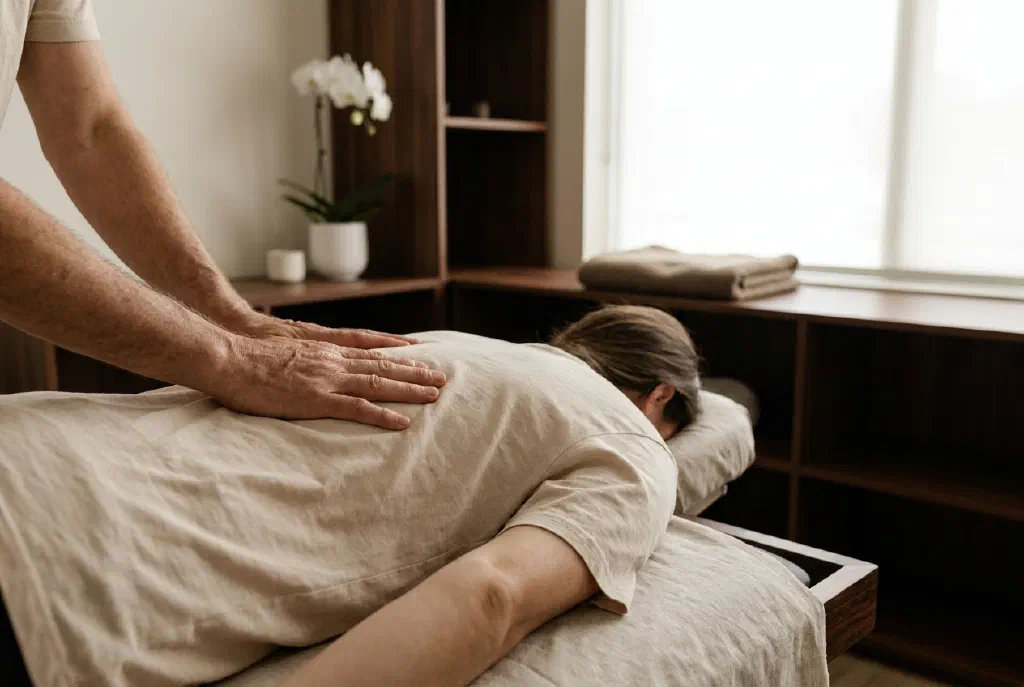
You then lie or sit clothed on a couch in most cases; the work is often done through a thin cloth, so no oil is needed. The practitioner often begins with loosening, broad grips to prepare the muscles, then works specifically along the meridians and on individual pressure points. Tense spots are worked more intensively, with pressure dosed in the rhythm of your breathing. To finish, calming, outward-stroking movements round off the treatment. Plan for some rest afterwards and drink plenty of water.
Areas of application
Tuina is traditionally used for a wide variety of complaints, in the wellness field above all for relaxation and loosening. Frequently mentioned occasions include:
- Muscular tension in the neck, shoulder and back area.
- Stress-related complaints such as tension, inner restlessness and sleep problems.
- Tension-type headaches, often combined with neck and shoulder work.
- General exhaustion and the wish for an energy balance.
- As a companion for functional complaints of the musculoskeletal system.
For most people the most noticeable effect is loosened muscles and a soothing calm that often lasts for hours. Whether an “energy balance” takes place beyond that cannot be measured objectively. Tuina does not replace medical treatment. With persistent or unclear complaints you should have them assessed by a professional.
Tuina, Shiatsu or classic massage?
At first glance the Far Eastern methods resemble one another, yet there are clear differences:
- Tuina is the Chinese variant, working firmly and technically with many different grips, mobilisations and pressure on meridians – often clothed on a couch.
- The Japanese Shiatsu massage along the energy channels follows the same meridian concept but works more calmly, broadly and meditatively, usually with resting pressure on a mat on the floor.
- The classic (Swedish) massage works with oil on bare skin and targets purely muscles and fascia, without the TCM energy model.
- Related in approach is also the reflexology foot massage, which is meant to work via defined zones on the foot – though locally limited and not over the whole body.
Who it suits and when caution applies
Tuina suits most healthy adults who want to release tension and relax and who appreciate a firmer, technical massage style. Anyone who prefers it very gentle is often better served by a calm wellness massage or Shiatsu.
Caution is advised in certain situations: during pregnancy, with acute inflammation, fever, fresh injuries, skin problems, thromboses, osteoporosis or serious cardiovascular conditions you should consult a doctor beforehand. A well-trained professional will ask you about such points at the start anyway. When choosing a provider, look for solid training and take time for a preliminary conversation – trust is decisive in such a close-contact treatment.
Frequently asked questions (FAQ)
Does Tuina hurt? Tuina may be intense but should not be genuinely painful. At very tense spots the pressure can be felt as a “pleasant pain”, but it stays within a comfortable range. Speak up at any time if something becomes too much – the intensity can always be adjusted.
Do I have to undress for the treatment? Usually not. Tuina is classically performed in comfortable clothing or through a thin cloth, and oil is mostly unnecessary. It is best to wear loose, stretchy cotton clothing.
How does Tuina differ from acupressure? Acupressure works with localised pressure on individual acupuncture points and is well suited to self-application. Tuina is more comprehensive: it combines pressure on points and meridians with kneading, pushing, rolling and joint mobilisation, and is carried out by a professional.
Is the effect of Tuina scientifically proven? The underlying Qi and meridian model comes from experiential medicine and is not scientifically proven. What can be demonstrated are the mechanical effects such as better circulation and loosened muscles. With health complaints, Tuina does not replace medical treatment and should at most complement it.
How often should I have Tuina? That depends on your concern. For pure relaxation, a session as needed is enough for many. Anyone working specifically on stubborn tension often arranges a series over several weeks. An experienced professional will advise you individually.