Yoga for beginners: getting started, first poses and tips
In this article
Note: This article contains affiliate/advertising links. As an Amazon Associate we earn from qualifying purchases. If you click such a link and buy something, we may receive a small commission – at no extra cost to you.
For many people, yoga first sounds like contortions, incense and folks who were born flexible. In reality, yoga for beginners is very accessible – you need neither prior experience nor special flexibility, just a bit of space and some patience with yourself. It is a calm blend of movement, stretching and conscious breathing that helps many people switch off and makes the body more supple. In this guide you will learn what yoga actually is, what you need to start, seven simple poses for the beginning and how to turn them into a routine you will actually stick with.
What is yoga, really?
Yoga is a millennia-old practice from India that combines body postures (asanas), breath control and mindfulness. In the West, the body-focused style of hatha yoga has become especially popular for everyday life: a calm form in which you take up postures, hold them for a while and breathe consciously throughout. It is not about performance or looking as spectacular as possible, but about the mindful interplay of movement and breath.
That is exactly what makes yoga so pleasant to start with: you work at your own pace, compare yourself to no one and can adapt every pose to your body. If you want to know which other styles exist, you will find an overview in our post on the different styles of yoga.
What you need to get started
The lovely thing about yoga: the barrier to entry is low. With a few basics you are ready to go right away.
- Mat: A non-slip yoga mat (around 4–6 mm thick) gives you grip and cushions your knees and spine. A rug works for the first attempts, but a mat makes it much more comfortable.
- Clothing: Comfortable and stretchy – leggings or jogging bottoms and a top that does not get in the way when you bend forward. Yoga is practised barefoot, which improves your footing.
- Space: A clear spot, roughly the size of your mat plus some room to move around it. Quiet, well aired and free of tripping hazards is plenty.
- Optional: A yoga block and a strap help make poses more accessible if you cannot yet reach down or forward very far. A rolled-up blanket does the same job at the start.
Nothing more is needed. In the beginning, go easy on the equipment and focus on body and breath.
Seven starter poses with breathing
These seven asanas form a well-rounded beginner sequence. As a rule, breathe calmly through the nose and let the breath accompany the movement: usually you inhale as you open and lengthen, and exhale as you fold and let go.
- Mountain pose (Tadasana): Stand tall, feet hip-width apart, arms relaxed. Inhale, lengthen upward, shoulders sinking back and down. This base pose trains your stance and body awareness.
- Cat-cow (Marjaryasana-Bitilasana): On all fours, alternate with your breath: as you inhale, let your back gently dip and look forward (cow); as you exhale, round your back and bring chin to chest (cat). This mobilises the spine.
- Downward-facing dog (Adho Mukha Svanasana): From all fours, push your hips up so the body forms an inverted V. Your knees may stay slightly bent. Keep breathing calmly and gently stretch your back and the backs of your legs.
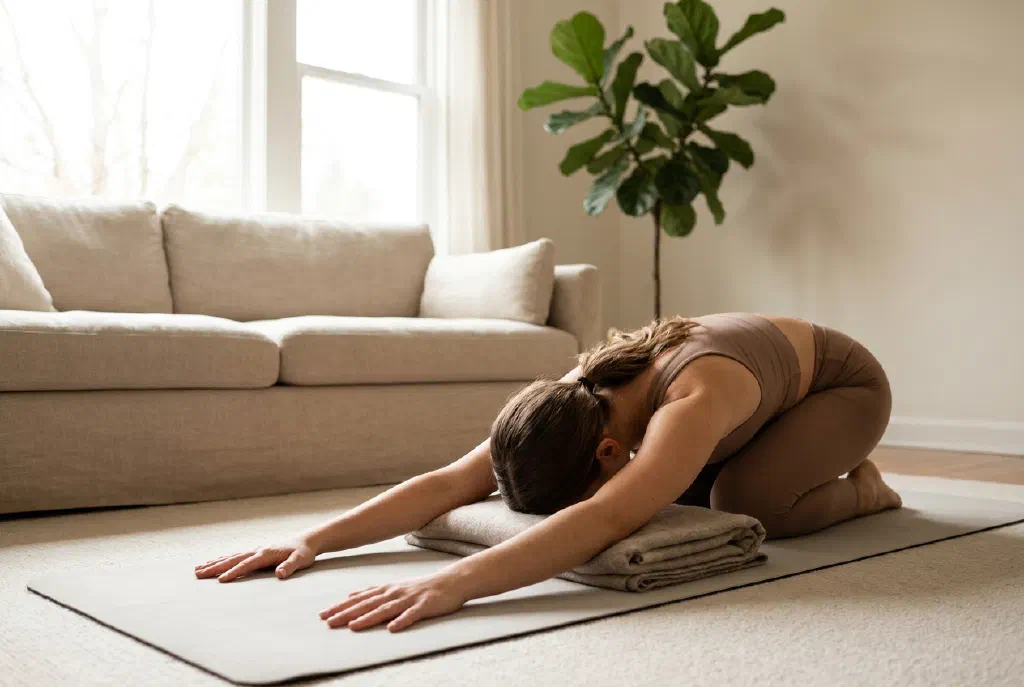
- Child’s pose (Balasana): Knees on the mat, let your hips sink toward your heels, rest your upper body forward, arms stretched out or beside your body. A resting pose you can return to at any time.
- Warrior 2 (Virabhadrasana II): Take a wide lunge to the side, front knee bent over the ankle, arms stretched parallel to the floor, gaze over the front hand. This strengthens the legs and opens the hips.
- Tree (Vrksasana): Stand on one leg, place the other foot against your calf or inner thigh (never on the knee), hands in front of your chest. A balance pose that trains focus and footing – wobbling is part of it.
- Lying down with breath focus (Savasana): To finish, lie flat on your back, arms loose beside your body, eyes closed. Breathe calmly for a few minutes and let your body grow heavy.
At first, hold each pose for just three to five calm breaths. If you also want to work on your breathing, you will find more ideas in our post on breathing exercises for relaxation.
Tips for getting started
- Start small: Plan for 10–15 minutes you can definitely manage rather than an hour you keep putting off. A routine grows from consistency, not from length.
- A fixed slot in your day: First thing in the morning or in the evening to wind down – a set time turns a good intention into a habit.
- Breath before depth: Never go so far into a stretch that your breath catches. As long as you can keep breathing calmly, you are in the right zone.
- Avoid common mistakes: Do not “force” yourself into poses, do not hold your breath and do not compare yourself with videos or other people. Pain is a stop signal, a gentle pull is normal.
- Remember to warm up: Begin gently with cat-cow before moving into more demanding poses.
If, after the first few weeks, you want to try a dynamic sequence, the sun salutation is the classic next step – a flowing series of movements that links several asanas to the rhythm of your breath.
Who is yoga suitable for?
Yoga can be adapted to almost any starting point and therefore suits very different people: those who dislike exercise as much as the sporty, the young as much as the older. Since you set the pace and intensity yourself, you can start small and progress slowly. If you prefer something even gentler or want to work specifically on your core and posture, you can also try pilates for beginners – a related, equally beginner-friendly approach.
Yoga is intended as a lifestyle and wellness practice that can support switching off and staying mobile. If you have health limitations, complaints or pain, talk to a doctor beforehand about whether and how you should practise. Yoga does not replace medical treatment, but it combines well with other relaxation techniques for stress relief.
Frequently asked questions (FAQ)
Do I need special flexibility for yoga?
No. Flexibility is not a prerequisite but a possible result of regular practice. Every pose can be adapted – with bent knees, a block for support or a smaller variation. You always start exactly where your body is right now.
How often should I practise as a beginner?
Consistency matters more than length. Two to four short sessions a week of 10–20 minutes each are a good start. If that feels easy, you can increase length and frequency as it suits you.
What time of day is best for yoga?
That is a matter of taste. In the morning yoga can leave you awake and supple; in the evening it can help you wind down. Choose the time you can fit in most reliably – the best time is the one that fits your day.
What should I wear for yoga?
Comfortable, stretchy clothing you can move freely in, such as leggings and a top that is not too loose. You practise barefoot, as this gives you better grip on the mat. Special yoga wear is nice, but not a must.